
By Susannah Cox Maddux, with support from Ali Sulko
Leah Yetter for Mercer University
“A life full of accomplishments but lacking in relationships is not a happy life.”
Dr. Vivek Murthy
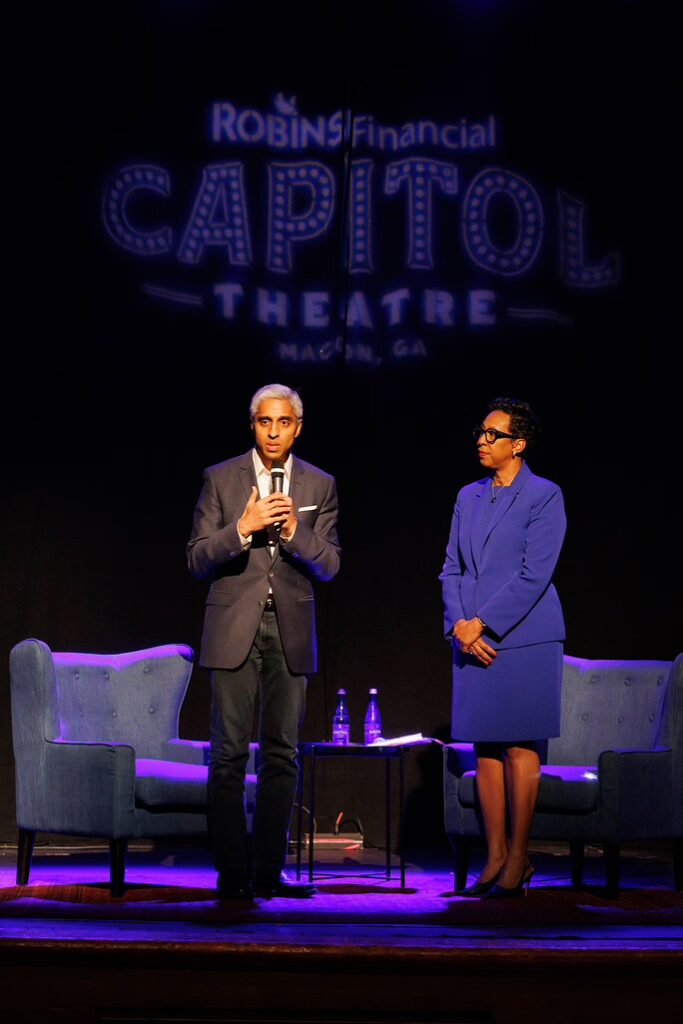
In February, U.S. Surgeon General Dr. Vivek Murthy visited Macon for a stop on his listening tour for The Together Project, funded by Knight Foundation. Dr. Murthy has focused on prioritizing social connection and community building in America since his first term as Surgeon General of the United States from 2014 to 2017.In his 2020 book, “Together: The Healing Power of Human Connection in a Sometimes Lonely World,” Dr. Murthy argued that loneliness is more than just an emotional state: it is a public health concern with significant impacts on physical health. According to Knight Foundation, he believes that addressing loneliness is a societal priority and calls on leaders in business, education, healthcare, and government to cultivate environments that support community and connection.
The room at The Capitol Theatre was full, and his message was profound in its simplicity. The notion of the need for community isn’t something new, but as I told Dr. Murthy in our post conversation interview, his work is rooted in teaching the need for community, not unlike ancient Bhagavad Gita, biblical, and Islamic texts.
I’ve thought: We’ve known this. We just forgot. It’s not something new. But I think the power lies in his putting a name to what so many are experiencing in the context of our current culture.
After his “powerful” talk, a word I heard in follow up with friends and colleagues, I had a conversation with Dr. Murthy.
“At this most basic level, I want us to recognize the power of human connection and community, and I want us to be able to prioritize that in our lives. I don’t think anyone would argue that relationships aren’t important,” said Dr Murthy. “But the question is, do we fully understand how important they are to our happiness, to our health, to education, to economic well-being? And do we also prioritize the building of community and relationships as much as is needed?”
Dr Murthy delved into his own personal experience and discussed how while it is great for one to focus on their own goals, it can often hurt their relationships and lead to less happiness within your own life.
“So I want everyone to recognize the power and importance of relationships and community and to feel like they have the permission to make that a priority in their lives, invest their time, their effort, their energy in building community,” said Dr Murthy.“If we can do that as individuals, then we can start making a priority in our communities more broadly, which is reflected in how we allocate resources, in the policies that we develop and shape and the programs that we build. Then I think we can build a society that’s as strong and vibrant and resilient because it will be ultimately grounded in social connection.”
While Dr. Murthy discussed his philosophy, he also talked about his time in Macon and how he saw his own teachings reflected.
“There’s a lot that I’m taking away from the brief time in Macon,” said Dr. Murthy. “I feel tremendous appreciation just for the enthusiasm here to actually build a stronger sense of community and for people’s engagement and doing the work of community building.”
Dr. Murthy spoke about the deep sense of service that runs through the heart of Macon and how he saw that everyone works hard to support the community. He went into detail about how there is always someone willing to put in the work and give back to their hometown.
Another thing that Dr Murthy found interesting during his stay here, is that Macon has a unique way of handling large projects. Rather than relying on large organizations to handle micro grants and institute new programs, the individual pushes for most of the change and does so successfully.
He observed how dedicated Maconites are to reflecting and building from their past. Maconites work to grow from their past and not let past conflicts and tragedies define their behavior nor separate themselves from each other.
“And at some level, we also need to be able to have real conversations about our stories and what we’ve been through,” says Dr Murthy. “It doesn’t mean we have to solve everyone’s problem. It doesn’t mean that we have to completely reconcile and resolve all the injustices that we may have all experienced. But I think that there is great power even in knowing that somebody acknowledges what you’ve been through, but they respect your experience and that they see you fully for who you are.”
When asked if Dr Murthy had anything to prescribe Macon he found that he didn’t and rather, he talked about the good foundation that Macon and its community had and how larger cities, like Washington D.C. could learn a lot about the good that a strongly built community can bring about.
“I always tell my team that we need to get out on the road. We need to go reengage with communities to be inspiring, to be reminded of who we’re serving and to learn,” said Dr Murthy. “And that’s what I feel like I’ve been able to experience here in Macon so I’m very grateful for that.”
In addition to Dr Murthy’s experience in Macon, he talks about what loneliness truly means and how individuals can work to combat it in their own lives. Dr Murthy offers three main things to realize when facing their loneliness.
“For folks who are struggling with loneliness, I would say to them at first, just recognize that you’re not alone. A lot of people are struggling with loneliness. You just can’t tell from the outside,” says Dr Murthy. “And second, to realize that our loneliness is not a reflection that we’re broken. And it doesn’t mean something’s wrong with us, inherently. The third is just to remember that building connection in our lives is about the small steps that we take. It’s not about massively transforming everything, leaving our job, moving to a different city.”
Dr Murthy said that giving back to the community can be one of the most powerful ways to escape loneliness and connect with others. By reaching out and working on volunteer projects, people are able to escape their isolation, as well as help out their community. Volunteering is a mutual relationship that benefits both the individual and the community in which they are placed.
I wondered what advice he would give to parents or those who are nurturing here in Macon, in
addition to fighting loneliness. His advice?
“I think as parents, we have to remember that the most important thing we can do for our child is to love our child and to make sure that they know that they are loved,” said Dr Murthy. “There’s a lot of things we want to do for our kids when we want to keep them safe. We want to make sure that they’re educated and to make sure they have access to opportunities, make sure they’re physically healthy. But at the end of the day, if you love your child deeply and your child knows that that’s one of the greatest sources of protection and support, you can give your child even long after you are gone. And the second thing I would offer parents is, I’d encourage parents to talk to other parents about what they’re going through, including their challenges in parenting.”
Dr Murthy stated his time here will continue to stay with him even after he returns home. “I’m so very grateful for that.”