
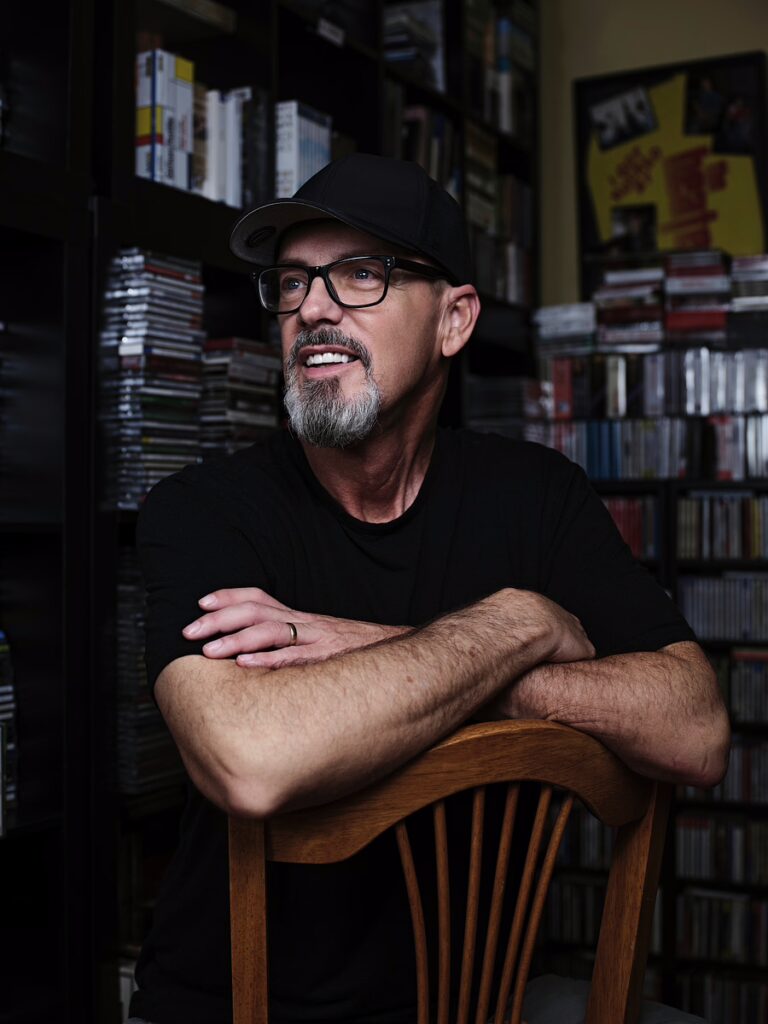
He once considered himself just a “fanatic,” but he became a renowned collector and writer cataloguing the acclaimed composer’s life.
Story by Michael W. Pannell | Photos by Matt Odom
You wouldn’t think Central Georgia would be home to the Western world’s largest archive of books, articles, photos, music, and memorabilia for one of the most acclaimed composers of the 20th century.
But it is.
In Warner Robins, a retired engineer named Bryan Rowell, who spent his career in radar software, has spent decades amassing material on Dmitri Shostakovich, the Soviet-era composer considered to be among the elite of his craft and called by the English National Opera “one of the most compelling and innovative composers of the 20th century.”
Shostakovich’s works were celebrated worldwide during his life and still are today, but he often created them while navigating run-ins with the monstrous Soviet dictator Joseph Stalin, finding himself dangerously on the outs with him. At times, Shostakovich’s music boldly conveyed his anti-government thoughts and emotions; at other times, it was forced to be guarded, yet laced with musical irony, to hide his and the music’s meaning.
Some of his works were banned in the Soviet Union, and were it not for his international fame, he would have undoubtedly suffered a much worse fate under Stalin. After Stalin’s death, Shostakovich found new freedom to express himself, even adding clear vocal music to his compositions.
“My interest in Shostakovich kicked in while I was at Auburn University,” Rowell said. “I was in a record store that was playing the fourth movement of Shostakovich’s Fifth Symphony. I didn’t know what it was, but there was a lot of brass in it, and I loved it, so I asked about it, thinking, ‘I’ve got to look into that.’”
Rowell has a musical background. He’s played trombone since the fifth grade and continued in Northside High School’s band program, where he also took up drums during marching season and played for NHS drama productions. That led to playing in church and with a rock band, The Heaters, that traveled Georgia playing dances, fraternity parties, and the like.
At Auburn, his musical abilities gained him a spot with The Auburn Singers and Dancers, which took him across the U.S. and Europe. Add a cello to the instruments Rowell learned, and now, due to neuropathy limiting his other musical efforts, he’s taken up singing bowls — for which he has a TikTok following.
While Rowell called himself a Shostakovich fanatic from his first hearing of the composer, the advent of the internet skyrocketed his research and collecting of articles and books — many, if not most, in Russian. He even learned some Russian to navigate materials.
It was the internet that expanded Rowell’s contact with the DSCH Journal, the leading international publication for Shostakovich studies, covering biography, interviews, reviews, and archival analysis. The DSCH name is a musical monogram Shostakovich used to represent himself, based on a four-note German musical cryptogram.
Rowell had subscribed to the journal for years and began an online correspondence with its France-based editor-in-chief, Alan Mercer, offering items and information. That proved an invaluable resource and combined with the journal’s own cache, led to his serving in several roles with the publication, including columnist, feature editor, and social media manager. He also wrote a series in the twice-a-year publication on what Shostakovich was doing 50 years earlier to the day during the period each issue covered. It only ended in 2025, 50 years after the composer died in 1975.
“I offered to help, and they said yes,” Rowell said. “Now the archive is here, and I have several roles with the journal. Because much of what they were putting online was coming from me, they made me media manager. I’ve collected a lot of news photographs of Shostakovich through the years, and with them, news articles of his visits to the U.S., which I could research. Fortunately, he lived in a time when there were such things, versus someone who’s researching Beethoven. It was that information that let me do the series.”
Rowell’s work and that of the journal have gotten nods of approval from Shostakovich’s widow and family, and he’s had the opportunity to be in contact with and interview them. His scouring of sources has even led to buying never-before-seen negatives taken by reporter-photographers covering the composer. The continual appearance of one individual next to Shostakovich in countless pictures led him to find the composer’s U.S. translator, a valuable resource.
Musicians, conductors, and others continually seek information from Rowell. He hopes to one day make the entire archive available online and see it physically hosted in a better location than his home. Rowell’s interest has also resulted in an Amazon business selling classical CDs that he collects and sells.
The DSCH Journal’s website is dschjournal.com. It is also on Facebook and other social media platforms under the DSCH Journal name.