
Story by Julia Morrison | Photos by Matt Odom
Since 1971, Grant’s Lounge has been holding down Downtown Macon. Founded by Edward Grant, Sr. as a place for everybody, at a time when that certainly wasn’t the case for a segregated Macon, the mix of groovy dive bar and music haven turned into an explosion of creativity. For siblings Cheryl Grant Louder and Edward Grant Jr., getting behind their father’s vision and keeping the business going was second nature.
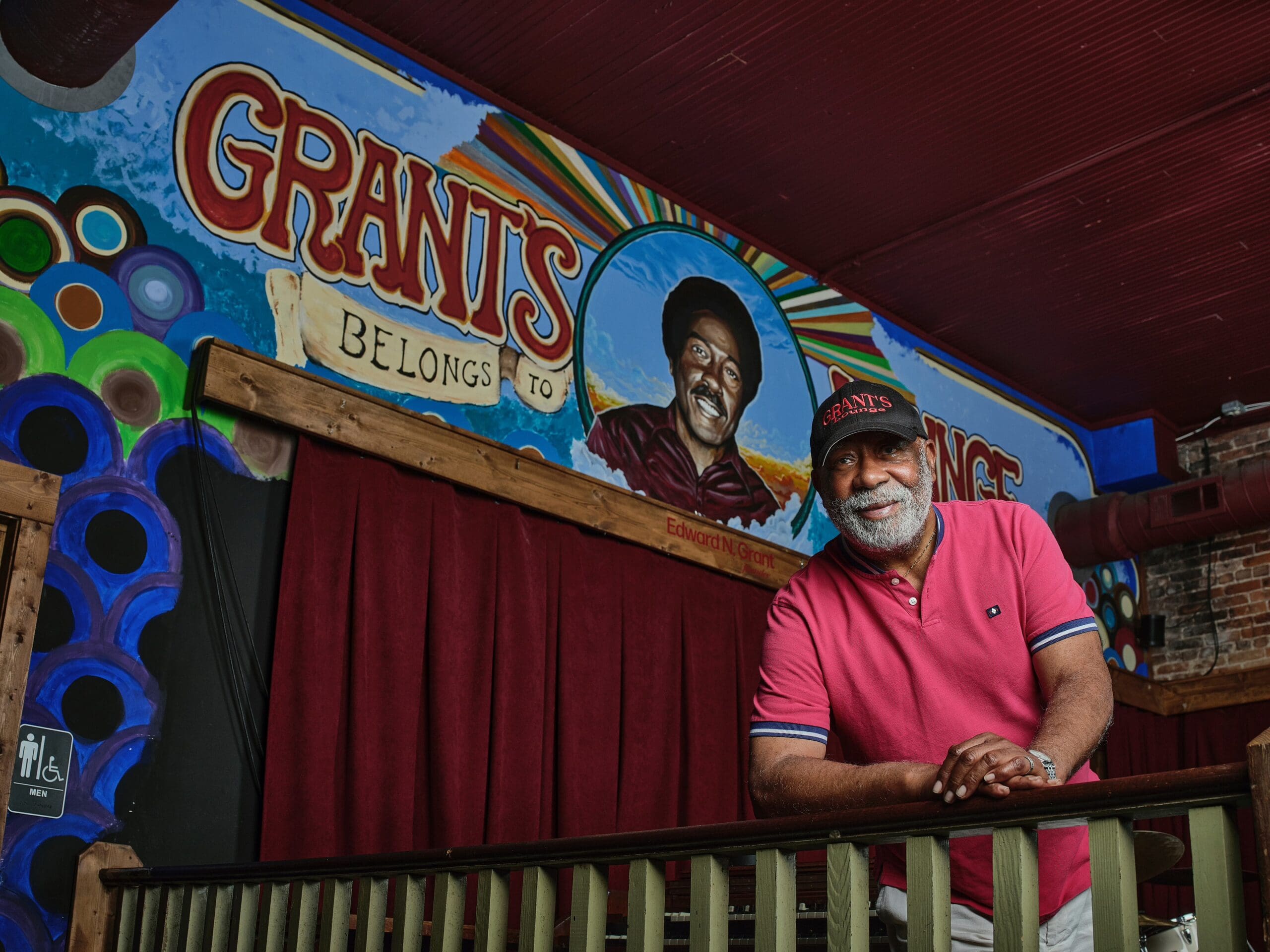
Over the years, the two became stewards of one of Macon’s most enduring cultural institutions, which is known today as the birthplace of Southern Rock. Grant’s Lounge has now been lovingly transitioned into the ownership of Moonhanger Group. In this conversation, they reflect on the people who built Macon’s music community, the challenges of keeping an independent club alive for generations, and why the soul of Grant’s still “belongs to the people” as a mural proudly proclaims above the stage, crafted by local artists Johnny Mo and Kevin “Scene” Lewis with a photo of Edward Sr. in the center.
How would you describe the personality of Grant’s? What does it feel like?
Cheryl: When people walk into the doors of Grant’s Lounge, I would like for them to feel more relaxed, at home. I just like for people to enjoy the experience of the music that Grant’s Lounge provides for everybody. It’s a place for everybody to enjoy.
What I remember is my dad letting us know that he was getting ready to open up a facility, a venue for all people to come in and gather for music purposes. My daddy would bartend at different places, and he did not like it, because the owners of these bars did not let anybody play. They had “picks and chooses.” And my daddy was the opposite. He wanted everybody to be a part of it and a wider music range.
After I graduated from high school, my brother was already doing cleaning up here at Grant’s, and I just asked my dad, did he need some help? I came down, and then pretty much been here all my life.
While you guys were running the place together, what were your roles?
Cheryl: My role was the books. I would always do inventory, order, balances. I would do all my W-2s and I do all the payroll. What flusters me the most is when I’m off a penny and couldn’t figure it out.
Ed: I ran the register on most nights. I helped with the promotions and coming up with the different concepts in order to keep the cash flow.
One of the things I wanted to ask was who you think has made a big impact in the music community.
Ed: It’s from different perspectives, because some people are musicians, but some people are supporters in different roles. Take Wes Griffith, for instance. He’s not a musician but he’s made a big contribution to music. Johnny Hollingshed Jr., Johnny Mo, John Griffin. I’ve seen Johnny Hollingshed take a bunch of musicians home at three o’clock in the morning and made sure they get home safely. Those are things that people don’t see.
And Lafayette Haynes — wow. Been a DJ in Macon since back when Hamp Swain was there and been spinning records. Got the biggest collection of vinyl in Macon for the last 50 years. He knows everything, everybody that ever did anything in music, but nobody really knows him.
I was sort of apprehensive about doing the interview because there’s so many people that are deserving of this kind of recognition far more than I do, I think.
I think you’ve done a lot. Did you ever imagine when your dad started Grant’s that this would become such an important part of the music community, not just here in Macon, but nationally?
Cheryl: I think it just grew bigger over time, because we did not have a clue. I know Dad did not have a clue. We would have people coming in like Patrick O’Neal, producers from movies filmed here, Little Richard did part of his movie upstairs. We had so many different turnovers. But with the music, I never would have thought that it would last this long, especially with us being harassed, and it took us through a lot of ugly things.
What made you stick through it through the hard years?
Cheryl: I love making people happy. I would stay here until three or four o’clock in the morning, just to make sure that people have a good time. I enjoy it. That’s what made me stay.
Have you ever realized that this bar changed somebody’s life?
Ed: The biggest thing that I’ve seen or heard is all of the people that say, “I met my wife there. I met my husband there.” I hear a lot of stories like that over the years. Then of course, the musicians. We’ve had a lot of international musicians come through and visit Macon and then come to Grant’s and play.
Cheryl: Most of our musicians that play on Sunday jam have original music. They play with other top bands and stuff like that. It’s just amazing how people walk in and they just say, “Oh, I feel it,” and play.
You two made the decision, instead of just closing down, to pass the torch over to Moonhanger Group. What guided that choice?
Ed: The club business is a different animal than any traditional-type business. Things have changed, and the way that you operate a business like this is just a lot different if you’re going to be profitable with it. But our employees also were with us 20, 30, and 40 years.
Cheryl: We started back in 2014 looking for a person.
Ed: A long-term solution. We talked to a lot of people from Atlanta, Florida. We went all over looking for someone to partner with us. That’s what I was looking for: the sustainability of Grant’s long-term.
When I found out what Wes [Griffith] was trying to develop, I found that he might be interested in Grant’s. We actually pursued him.
Cheryl: Eventually we were able to work out everything, and I am just happy as I can be, because we’re getting up in age. I’m 73. I don’t know too much about computers and stuff like that. It’s just a relief for me because I couldn’t have taken it to another level unless I would have went back to school.
Ed: Even with the POS systems that they’re using, everything’s just done so differently than when we used — like Cheryl told you, she was using a pencil and had an eraser on it.
Cheryl: I asked the girl here the other day for the tape, and she said, “Tape?” I said, “Yeah, the cash register tape.” She said, “I never heard it called that before.” I said, “See, I don’t need to be here anymore.”
In your vision, what do you think Macon is capable of?
Ed: I heard Josh Rogers make a presentation that blew me away about the potential of Macon and comparing it with other cities around the world. He talked about the wide streets, about the Ocmulgee River, about the capacity of Macon being able to have the infrastructure to support so many people as a city.
But I would have to refer you to the Storytellers Macon story that I told about “Music Makes Macon Magic.” When you’ve got five genres of music that come out of a small town of 150,000 people, man, that’s powerful. There’s nothing you can do that can ever change that.
And when you think about the kind of struggles, the moans and groans that inspired the culture and the music — that’s soul.
David Ruffin and Marvin Gaye competed in the studio as to who could sing the highest note. David Ruffin sang the note perfect pitch. Marvin Gaye was off pitch, but it had so much soul in it they had to give him the winning token.
So when you got soul in a song, in what you’re doing, it just makes all the difference in the world. And that’s what Macon has — it still has it right now. It comes out on that stage right there, and it has come out on that stage for the last 55 years.
What does being a hero mean to you?
Cheryl: Success. Well-known.
Ed: Somebody that goes beyond the call of whatever is required.
Is there anything else you’d want our readers to know?
Ed: I’ll say again that Macon Magazine has brought to fruition the desires of Macon’s community, both Black and white, over the last 10 years. I’m very, very proud of what they have done… It looks like Macon.
Thank you. That’s what we hope. We want it to feel like Macon, and we want people to all see themselves in it.