
Story by Brittny Johnson | Photos by DSTO Moore
Behind every city meeting, public record, and elected official is an unsuspecting team quietly keeping Macon-Bibb County running. When people think about city government, they usually picture elected officials and senior staff: standing behind podiums, debating policy, showing up at city events, or cutting ribbons at new developments. What they don’t often see is the team working long after the public meetings end; those who are filing documents, preparing agendas, and preserving records so that the showstopping moments can happen.
Without them, local government would slow to a halt.
Inside the Macon-Bibb County Clerk’s Office, leadership doesn’t always look like the person who is standing behind a microphone. Instead,, it looks like preserving history, solving problems before anyone notices them, being clear on the rules, and making sure everyone else can do their jobs. But what is noticeable instantly, is a team of people who truly enjoy working together for the betterment of the city.
At the center of the that team is Janice Ross, the longtime cClerk of the Macon-Bibb County Commission.
“Our office supports the pension boards, the Pedestrian Safety Review Board, the Martin Luther King Commission, the Principals Friends of Rosa Park Square Board, the Construction Board of Appeals, the Complete Streets Commission and several others,” Ross explained. “By support, we do agendas and meeting minutes for all of that.”
Most of that work happens quietly in the background, but it has a direct impact on how local government functions. In recent years, Ross has also worked to modernize the office. Through a new document management system, contracts, ordinances, resolutions and deeds are now available online, a process which givesing citizens easier access to public records.
“One of my goals was to be transparent,” Ross said. “I think by doing that, we’ve achieved the transparency that we wanted.”
That commitment to transparency is only one part of the office’s responsibilities. The clerk’s office also manages approximately 2,500 open records requests each year, a mammoth task when each is governed by strict legal deadlines.
“We have a three-day limit to acknowledge or respond,” Ross said. “I look at every open records request every Monday and Friday. It’s very time-consuming, but it’s very important.”
While Ross oversees government operations in one building, another kind of history is carefully being preserved in another.
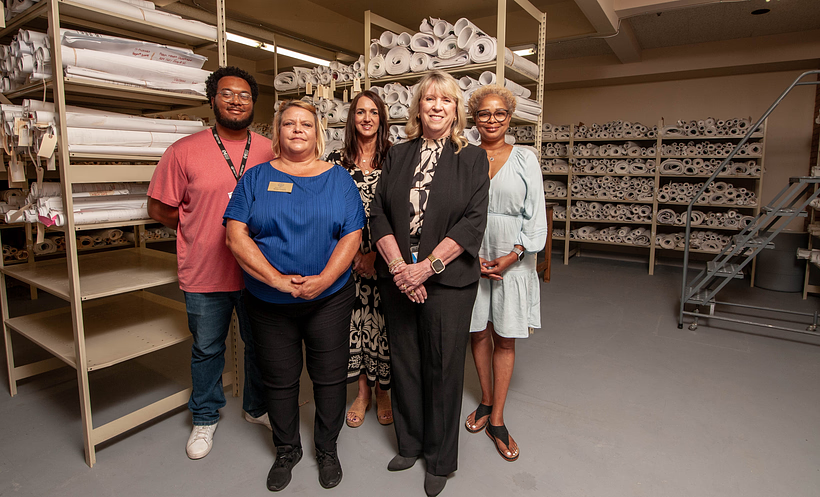
Walking into the Archives and Records Center feels like stepping into a city’s Macon’s memory. There are tons of shelves containing decades of history from marriage licenses, payroll records, and retirement files,from marriage licenses, payroll records, and retirement files to criminal evidence, and documents that help families trace generations of their ancestry. Every box is labeled purposefully, and every document matters.
The mManager of the Archives and Records Center,, Kitty Cosper, knows those shelves almost by heart. Protective of the records under her care, she laughs about once threatening to barricade the doors after realizing unauthorized people could access “her” archives.
“These records aren’t open to the public,” Cosper said. “If something goes missing in here, I have to answer for it. They’re our responsibility.”
That sense of civic ownership extends beyond organizationorganizing files.
“Sometimes people need something from their history a long time ago to get a job,” Cosper said. “District attorneys may call to get evidence to help with murders. Retirees need employment records before receiving pensions. Even in genealogy, there are so many important things about this.”
Assistant to the Archives and Records Manager, Isaiah Hawkins added that marriage licenses remain among the most requested records.
Cosper smiled as she recalled local historian Brenda Sutton Williams (featured in the April/May Women’s Issue) spending hours researching family history.
“She found her great-grandfather’s information here,” Cosper said. “We give her a table and let her go at it.”
For Cosper, there’s a sense of genuine satisfaction in helping people find what they’re looking for.
“If it’s in this records center,” Cosper said with a smile, “we’re going to find it.”
This team’s leadership becomes even more apparent during times of transition or when challenging situations arise. Ross and Deputy Clerk of Commission, Sheila Griggs, recalled one of the office’s most difficult moments when the county’s longtime mailing vendor suddenly closed after the owner’s unexpected death. Court notices still had to be mailed. Deadlines still had to be met. For weeks, the clerk’s office became its own mailroom.
The team purchased stamps, stuffed envelopes by hand and took turns driving bins of mail to the post office.
“People didn’t know we were doing that,” Ross said. “They just knew the mail had to go out.”
The office also navigated a countywide cybersecurity incident a few years ago that temporarily shut down systems, delaying access to records while staff adapted to new security procedures.
“You just get through those things,” Ross said. “It’s temporary, and you just have to be tough during that time.”
Often, the staff spoke less about individual accomplishments and more about one another.
“I don’t have to babysit anybody,” Cosper said with a laugh. “Everybody knows what needs to be done, and they do it.”
Ross agreed.
“I can personally say that this is the best group I’ve ever had,” she said. “They are all fabulous in their own right.”
When asked whether they consider themselves leaders, no one mentioned titles. Instead, they described leadership as taking initiative. Deputy Clerk Sheila Griggs sees leadership in accountability.
“I take the initiative afterward to remind people, ‘You said you were going to do this. Do you remember?'”
Assistant Clerk Melissa Touchton finds leadership in helping commissioners grow professionally. She carefully tracks continuing education opportunities, certifications, and specialty training, often encouraging commissioners to complete additional coursework through the Association County Commissioners of Georgia.
“I probably care more than they do sometimes,” she joked. “I really want them to finish.”
Ross believes leadership has been shaped by those who challenged and encouraged her throughout her career.
“I think it’s the people around you that help you understand that you are a leader,” she said.
That philosophy has carried throughout the office. Every member continues professional development, earning certifications and expanding their knowledge to better serve the city.
For Ross, the greatest reward comes from helping residents understand how their government works.
“I think helping citizens understand government and being as transparent as we can is important,” she said. “People sometimes have suspicions about what goes on at City Hall. That’s one of the reasons I wanted to put everything online.”
For Griggs, it’s her motivation is much simpler.
“I enjoy helping the customers,” she said. “Sometimes people just need someone to point them in the right direction.”
For Cosper, appreciation often arrives in unexpected ways.
After helping an attorney locate a difficult record, the grateful client mailed the office cookies as a thank-you.
“We’d never even met her,” Cosper laughed. “But those cookies were good.”.
Inside the Macon-Bibb County Clerk’s Office, leadership is measured differently than other places. It is measured met through the decades of carefully preserved history, the thousands of public records processed each year, commissioners equipped to serve their communities, court notices delivered on time, and countless problems solved before the public ever knows they existed.
Many residents could name the mayor or their county commissioner, but will never know the names of the people making those their work things happen. And while they’re the clerks are perfectly fine with that, their work should be acknowledged. It’s the kind of leadership duty that doesn’t make the headlines, but without it, Macon-Bibb County simply wouldn’t work.