
Story by Julia Morrison | Photos by Jessica Whitley
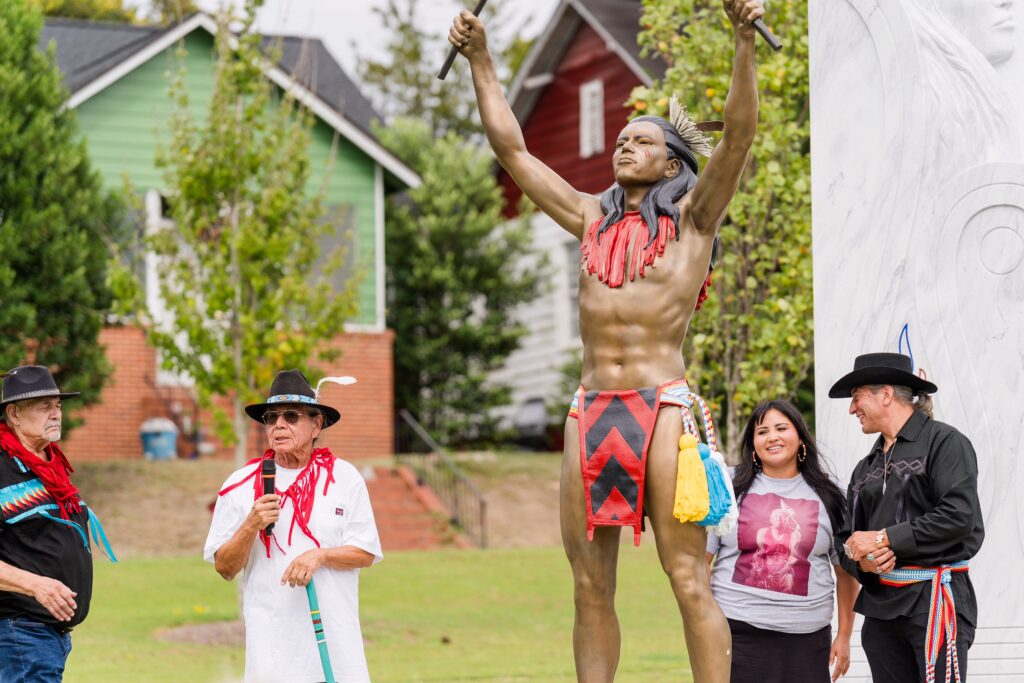
The wind whipped dramatically, blowing off the black cloth to reveal the face of Netche “Cepvnkv” Gray to the crowd, staring straight towards the west toward Oklahoma while raising his arms and stickball tools high in the air.
Based on his legacy, Gray, a Muscogee (Creek) culture-bearer and World War I veteran, would have understood the power of sharing stories that transmit one’s history and heritage to the next generation. He may not have ever imagined that his story would be the one etched in bronze and marble, making an impact in the ancestral homelands of his people.
For nearly 200 years in Macon and across Georgia and Alabama, the story of the Muscogee Nation has been told using the language of removal. The pain of forced migration, unfair and coerced treaties with the United States Government, and the loss of the land that had been stewarded for thousands of years has been told locally through a lens that can be inaccurate, stereotypical, or plainly untrue. This has made the distance feel longer between the banks of the Ocmulgee River and Okmulgee, Oklahoma, where the Muscogee Nation headquarters now sit.
But this past September, that story took on a different shape, part of a number of cultural reconnection efforts between people who live in Macon today and Muscogee citizens over the past several years. Standing more than seven feet tall on a base of Georgia marble, sculptor Kenneth Johnson (Muscogee/Seminole) installed the likeness of Gray to complete the striking Bicentennial Park piece “ECKE – Mother Ground.”
Gray had been part of an unbroken lineage that passed down Muscogee songs, stories, language, and traditions in spite of removal and concerted efforts to oppress Indigenous self-expression. The sculpture was unveiled a day before the Ocmulgee Indigenous Celebration, where Southeastern tribes gather in Macon for a weekend of joy and culture at the Ocmulgee Mounds.
What should Maconites take from the sculpture? For Johnson, it’s simple: “I want them to see that we’re still connected, and we’re still here. And this is — even though it’s an elder that’s passed on — this is still an alive, current culture and community that is actually going to be here playing stickball,” he said.
This distinction is important. This sculpture doesn’t just intend to commemorate someone who is gone – or indeed, a whole culture that is gone from the area. It points towards something that continues, the unbroken line of culture and traditions. For Johnson, Gray was an especially fitting figure to embody that connection.
“Netche is the inspiration for this bronze because I had the opportunity to meet him and ask his family members questions and learn more about him,” says Johnson. “He was a stickball player who had the right to wear the tiger tail, an element of significance while playing stickball. It was an honor given by others, not something you could choose for yourself.”
Stickball is a traditional game played both for recreation and ceremony by a number of Indigenous nations, including the Muscogee. Historically, the game is the direct precursor to the game of lacrosse, as the oldest practiced organized sport in North America.
Johnson first met Gray in real life as a child in the 1970s. Gray was imposing at six feet, four inches tall, particularly in Johnson’s childhood memory, so the sculptor chose to make the piece seven feet, three inches tall to show how striking he was. Johnson remembers him for teaching songs and leading Stomp Dances, and Gray’s work to preserve Muscogee culture turned into reference recordings for the Smithsonian.
Descendents of Gray, such as his grandson Joe Sulphur, now 76, continued to take up the mantle of stickball, and have continued to pass on the songs and stories. As a strong connection of the passage of time and culture, Sulphur remembers his grandfather saying to him that when Gray was Sulphur’s age, he had stickball opponents who had played in the Civil War.
Both the figures in ECKE face west, towards Oklahoma, to acknowledge the real history of why the tribe left and to acknowledge their current home. Johnson says his hope is to eventually have a twin sculpture in Oklahoma that faces east, towards the Muscogee homelands. The female figure carved in marble and the male stickball player create an interplay of balance and cultural symbolism. Gray’s sculpture also fronts a stickball-sized field to play the game in, with the hope being that as the region develops and Ocmulgee Mounds National Historical Park gains full national park status, that the game will one day be played locally.
Bicentennial Park is the culminating effort of Macon-Bibb County’s Macon200 celebration and was dedicated in November 2025. The tenor of the bicentennial celebration overtly meant to focus on stories that were untold or underexamined during the previous centennial celebration.
About a month prior to the completion of “ECKE – Mother Ground” Muscogee artist Starr Hardridge debuted the collective work “Medicine River” on the corner of the park, made in collaboration with East Macon artist Randy Heart. The individual tiles that make up “Medicine River” were made by the hands of different Macon citizens. One large scale artwork remains to be installed in Bicentennial Park, a series of panels that depict different aspects of Macon’s history etched in corten steel.
The sculpture effort is not alone in the ways that Central Georgians are connecting to the Muscogee Nation, aiming to shorten the distance from Ocmulgee to Okmulgee, and telling stronger and more accurate history about our Indigenous origins. Street signs downtown are now displayed in the Creek language. Depictions of Muscogee fashion line the shadow boxes in the alley ways.
While the bronze sculpture makes Gray seem larger than life, it might seem like a small thing, in the span of time that includes over 10,000 years of inhabitation by his ancestors on the spot where his likeness now stands. But just as Gray himself was a cultural link whose powerful presence united Johnson and Sulphur today to stickball players from the Civil War era, art has the ability to transcend time and space and change perspectives.
People in Macon are starting to know that the Muscogee people are still here and starting to welcome them back in stronger ways. When that happens and historic truths are told, it shortens the immense distance that has been built between cultures, an indelible rift where healing once seemed impossible.
Bicentennial Park stands in striking distance to the construction site for Macon’s new arena, which broke ground this summer and will host all kinds of sports and events. Echoing the idea that the history of the land could be a part of all projects, in all ways, Johnson playfully noted that he hopes stickball is part of that story, too:
“And when they build that new stadium, you should acknowledge the ball players that were there originally.”