
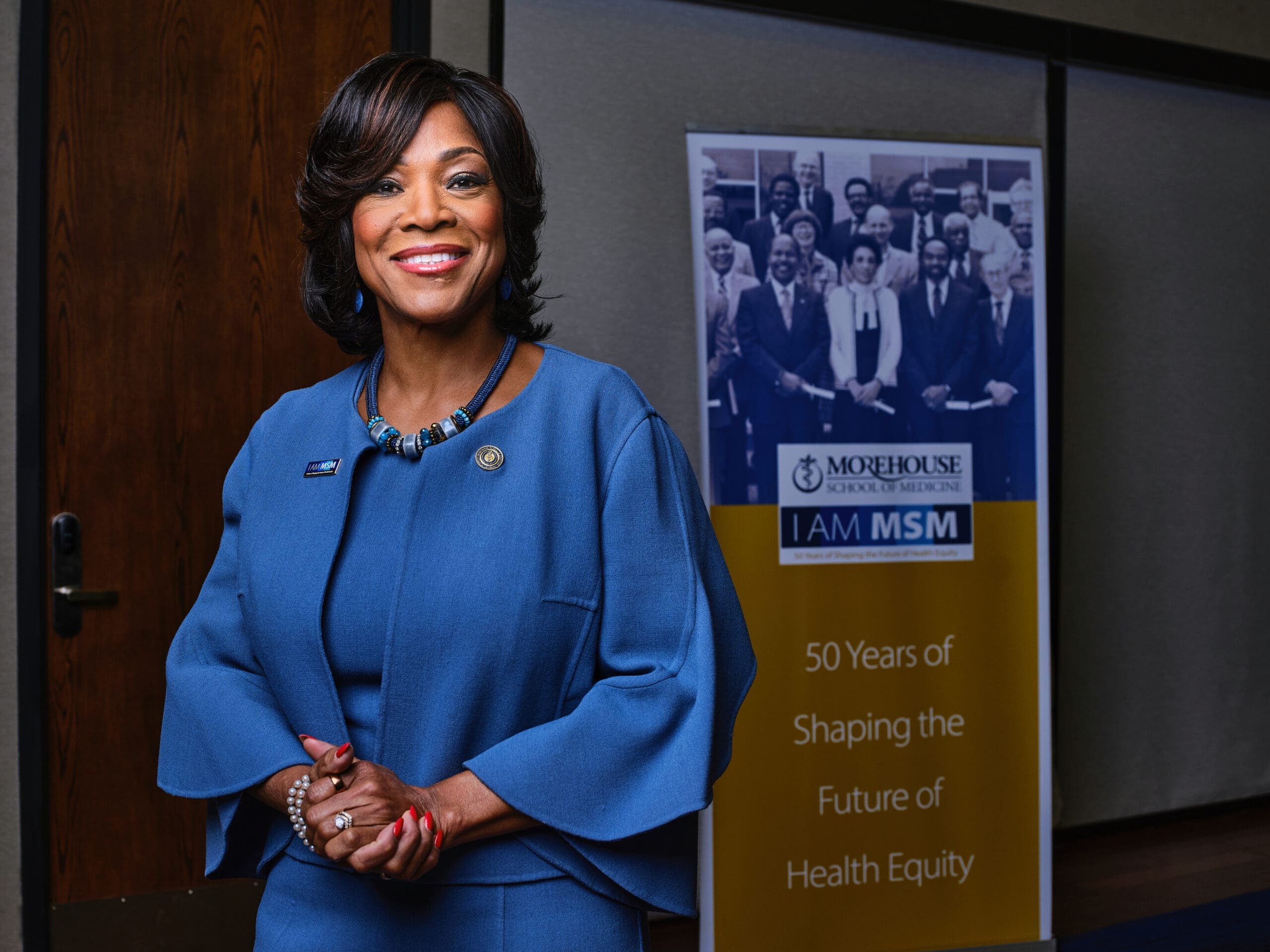
Valerie Montgomery Rice takes lessons from her Macon upbringing as she stewards Morehouse School of Medicine towards their 50th Anniversary
By Julia Morrison | Photos by Matt Odom
“I would tell them the sky is the limit. Believe in possibilities.”
That’s what Valerie Montgomery Rice, ten years into her role as president and dean of Morehouse School of Medicine (MSM), says she would tell a young aspiring to leadership today. “And my reasoning for that is because I grew up in a single-parent household.”
That household was in Macon, where Montgomery Rice came of age. Speaking in an executive role leading one of just four historically Black medical schools, Montgomery Rice may seem far from her roots now. But just up the road in Atlanta, she hasn’t forgotten what Macon has taught her – from beloved teachers at Southwest High School to a love of Nu-Way hot dogs (with fries and a chocolate shake) – that led to a passion for leveling the playing field in education and a dedication to training physicians who will improve health outcomes for Georgians.
FAITH, FRIDAY NIGHT FOOTBALL, AND FAMILY
Montgomery Rice’s journey to being a boundary-breaking woman – the first female president in MSM’s history – starts with another boundary-breaking woman, her mother. As a female machinist at Georgia Kraft Paper Company, Montgomery Rice’s mother was competitive in a male-dominated field and was able to achieve stability to raise four little girls. “That job changed the trajectory of our lives,” she said. “She was very clear that education was the equalizer and that she wanted more for us than she had ever accomplished.”
That included whispering positive affirmations in her girls’ ears when she would get home from the midnight shift: “All things are possible. You can be anything you want to be.”
“My mother did not know osmosis, but she believed in positivity and that that could change our lives,” Montgomery Rice explained. She said growing up in Macon meant a foundation of traditions, with faith, Friday night football, and family as anchors. Her path was also set by great teachers, at Matilda Hartley Elementary School and onto Southwest, where she was the homecoming queen. Rice names Gloria Washington, Ella Carter, and Mae Brewer as powerful women who pointed the way.
All of them pointed to a future without limits, regardless of the circumstances of one’s birth or social discrimination. In Brewer’s cooking classes, for example, “We would prepare these wonderful foods and then we would dress to actually serve ourselves and each other. We did this with minimal resources. She always said, ‘You don’t have to be rich to eat richly.’ Those [lessons] were the foundation of things,” said Rice. “So I would say to a young lady or a young person, you are not limited by the circumstances in which you were born – or even which you grow up in – but you do have to be willing to work hard with unimaginable anticipation of what’s possible for you and your future.”
EDUCATION IS THE EQUALIZER
That kind of purpose led Montgomery Rice to Georgia Tech, and later Harvard Medical School, where she trained to become an OB/GYN. Eventually, she settled into being an infertility specialist and a professor at the University of Kansas.
She started addressing inequity as the founding director of the Center for Women’s Health Research at Meharry Medical College, another HBCU medical school. This was a unique research opportunity dedicated to addressing the distinct health challenges faced by women, particularly women of color. This propelled her to eventually become Meharry’s dean.
When asked about challenges throughout her time as a leader, Montgomery Rice was candid: “Early on in my career, because I was a great student, lots of people always had advice for me about what I should do next… So I was letting other people more so direct my future than me directing my future, and it didn’t work out well.”
A new president came to Meharry and eventually asked Montgomery Rice to step down. She was devastated, but not deterred. “I said, okay, how do I turn this into an opportunity? I got an executive coach and really started to think about what I wanted for my career. I reconnected with my family, my husband, my two kids because I had been so busy and had not created any element of balance. I started to really reflect.”
This thought process led Montgomery Rice to Morehouse School of Medicine, with “a role that aligned with my passion and my purpose,” she said. She would have the opportunity to shape another historically Black medical school while returning home to her native Georgia. A couple of years after her arrival, Montgomery Rice was at the helm.
“We were founded to diversify the healthcare workforce, increase access, and work toward the elimination of health disparities. There’s no doubt about that,” she said.
ACHIEVING HEALTH JUSTICE
The mission of MSM is clear, and more relevant than ever. Before MSM was founded in 1975, the American Association of Medical Colleges reported in 1970 that across the country, only 2.2% of physicians were Black, despite Black people making up 12% of the U.S. population at the time.
In Georgia, it was bleaker. Despite the Black population making up double the share of people in the state than the national average, there were just 93 Black physicians at the time, according to Montgomery Rice. Despite making up such a small share of Georgia’s doctors, they were caring for the vast majority of the Black population.
“Who we educate and train, and how we educate and train people matters,” emphasized Montgomery Rice.
The founding of Morehouse School of Medicine in 1975 aimed to change that, by focusing on educating and training minority physicians. Dr. Louis Brown was one of those rare Black physicians in Georgia in the late 1960s, and he started to float the idea of creating a new medical school. Funding from the Josiah Macy Jr. Foundation led to a feasibility study that the Georgia Board for Physician Workforce used as evidence for the school’s mission.
“A place like Morehouse School of Medicine has a significant impact, because of how we recruit and retain students who go back and practice in those underserved communities,” said Montgomery Rice. She mentioned that a Georgia high school student who goes to MSM is likely to stay in the state of Georgia, even more so if they do their residency training in the state. “Connectivity matters. Cultural identity matters.”
“We are not being appreciative of the diversity and the complexity of the problems that we are being faced in healthcare, and how critical it is that we have diverse thinkers and people who have different perspectives and different distances to get to that table,” said Montgomery Rice. “If they can bring those life experiences to the table… then the richness of the solutions are going to be more applicable to a broader set of people.”
“It takes all of us in order to solve the complex problems that we are now facing in healthcare.”
Keeping doctors in the state can make a major impact on underserved communities, argues Montgomery Rice. This is especially true in Georgia, where rural communities are often healthcare deserts, many of which are considered part of the Black Belt.
She argues health equity can make a difference throughout a population: “If a primary care provider goes into a county, within two years, they are increasing the economics by $1.3 million a year, based on the number of jobs they produce in their practice and jobs that indirectly are produced because of the businesses that surround their practice. Then we see fewer days of missed work because people are healthy.”
When Montgomery Rice notes that education is the equalizer – a phrase she says often – she means it. “You ask yourself, what’s the connection between socioeconomic status and health? It really is education, because as people become more educated, they actually improve their socioeconomic status. They have more choice, they are more informed, they make different decisions that lead to good health.”
Educators bridge the gap between clinical settings and communities. “We also have to recognize, very importantly, that medicine is a team sport,” Montgomery Rice noted.
SEEING WOMEN IN THEIR FULLNESS
An example is maternal mortality, a crisis in Georgia that MM covered extensively in the December/January issue. Education and workforce development that focus on health equity are critical in turning around the crisis, where Black women face twice the maternal mortality rate as non-Hispanic white women. “It empowers women to understand that they have a choice. They are the decision maker of what’s going to happen to them in the future,” said Montgomery Rice on education.
“Once a woman chooses to become pregnant, what is the experience that she has? It matters who her provider is. We want them to be culturally competent and possess humility so that they see that woman in their fullness.” Montgomery Rice believes that connectivity built between a patient and a provider can help catch deadly issues, like hypertension, that occur in the postpartum period.
Another prescient issue for maternal health that Montgomery Rice advocates for is reproductive choice. “I think all women who are sitting in leadership roles in corporations, in medical schools, or the leadership role in their home – all of them are concerned about reproductive justice in one way or another. There’s no way in this country that you can be a woman and also be a mother, a sister, or aunt etc. to women and not be concerned,” she said.
“When they get pregnant, how they get pregnant, how many children they have – those are choices that should never be taken away from women. That is one of the critical issues that then bleeds into, unfortunately, what are my educational opportunities going to be? What are my opportunities going to be for me to sit in these roles that allow me to be a leader?” She continued: “I think a large part of it begins with the reproductive choices that we have as women.”
One way MSM is combating the maternal mortality crisis is by looking towards a nursing program, with a doctorate in nurse-midwifery as their first planned focus. This would give women more flexible choices for a provider, which might empower their health during pregnancy.
THE RIGHT TO SIT AT THE TABLE
Montgomery Rice has an approach that is working, as she marks the 50th anniversary of MSM and passes a decade as president and dean. The Atlanta Journal-Constitution wrote: “She has dramatically increased the number of medical students and has elevated the university’s role in working to help solve some of the biggest health equity problems of our time.”
The dramatic increase has nearly doubled the number of students that attended MSM before Montgomery Rice’s tenure, and they hope to double it again over the next decade to 225. She’s also been a prolific fundraiser, exponentially increasing yearly giving numbers by millions.
“What I’ve been most impressed with is that our mission has not changed over these 50 years,” Montgomery Rice said, “though leading the creation and advancement of health equity has evolved to achieve health justice. The reason for that is because we recognize that health equity is defined by giving people what they need when they need it, and the amount they need to reach the optimal level of health.”
Maybe Montgomery Rice’s boldness comes from the affirmations spoken to her at a young age. “I’ve never had imposter syndrome,” she said. “I would say to young people, don’t embrace this imposter syndrome. I’ve always believed that I had the right to sit at the table.”
Valerie Montgomery Rice has come a long way from the little girl in Macon whose mother whispered in her ear that she could do anything. But she’s still looking to the future, with eyes on transformation. “You start to see justice when you remove all of those structural barriers that have been put in place that don’t allow people to reach the optimal level of health,” she said.
“Morehouse School of Medicine will continue to do that. You will see us grow.” If Valerie Montgomery Rice’s record is any indication, that’s a promise.


