
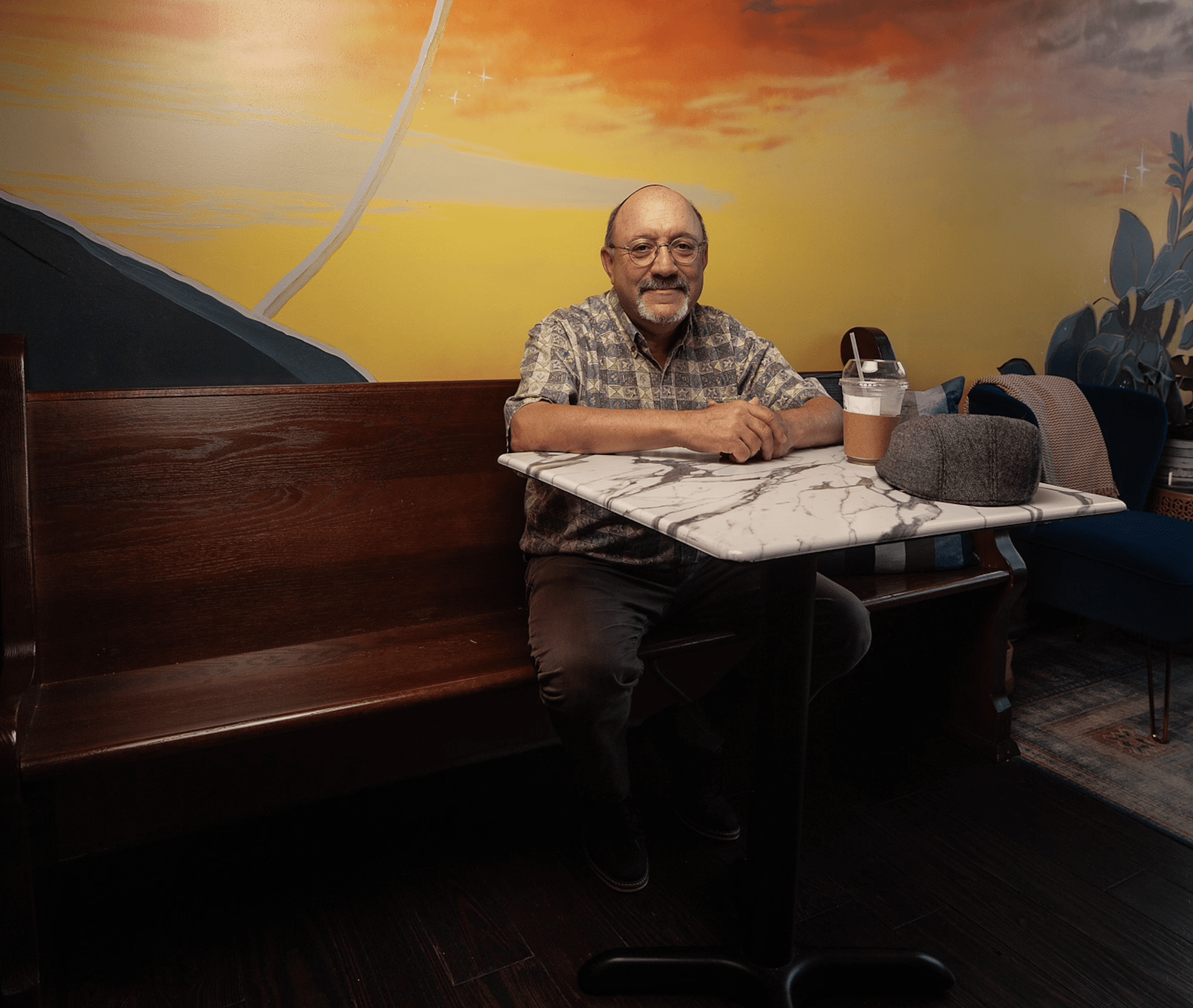
Interview by Julia Morrison | Photo by DSTO Moore
It could be the setup for a classic joke. A rabbi, an accordion player, and a hot sauce maker walk into a bar. The twist is, they’re all the same guy. The multitalented Aaron Rubinstein has called two of the world’s most iconic cities his home – New York and Los Angeles – but it was Macon that ultimately claimed his heart. Rubinstein first arrived to steward historic Congregation Sha’arey Israel in the early ’90s and, after a chapter in Memphis, decided to return for the part of his life he calls “Macon Part II.” In a city with strong Jewish roots and a growing creative community, he marks milestones across generations of Macon’s families. Here’s why this continues to feel like the place he’s meant to be.
What was the winding path that brought you to Macon?
I was a grad student in Manhattan. I graduated from the seminary where I got my rabbinical ordination in 1991, so you’re looking for jobs in the spring of that year. Three people from Macon – you might even know them – came to New York. They were Steve Krueger, Jami Gaudet, and a sweet man who’s no longer around named Ike Drazin. They interviewed me, and I guess they liked me.
You had just decided to apply randomly? Just like – Macon, Georgia, why not?
I decided to apply. I wouldn’t even know where Macon was, and a New York Jewish question would be, are there Jews in Macon, Georgia? That would be the obvious question.
I did not take the job in 1991. What happened was, I was offered it [and] my wife Sharona, who is a dancer and a bunch of other things, was dancing in Manhattan and she said, “Can we be in New York a little longer? I need to do some more dancing things.” At the same time, I was interning in a big synagogue in Queens, Forest Hills. I got the job as an assistant rabbi in Queens, which I had for two years. They told me early on, “Well, we only have money for this job to happen for three years.” That means I’m going to be looking before that, and as luck would have it – I’m having another interview, in Macon this time.
I came down and Jami Gaudet said, eyes locked, “You said no last time we offered you the job. So if we offer you the job, you can’t say no again.” I said, “Yeah, I’ll take it.”
Even the first time, we’re looking around [at homes] … The realtor showed us a few beautiful houses. Even though I wasn’t going to take the job, Sharona says to me – and it was the weirdest thing to say: “I just have a feeling we’re going to end up here.” And as we’re pulling away, she said, “I just have a feeling about this place.”
So in 1993, I started here. That was through 2005, and then there was an opportunity when I was thinking about family. I have two kids. One is 23, Maya. Zohar is 27. They were both born here. In my mind, when we have kids, what do we want them to have? Educationally, in a Jewish community. Maybe we need to look for something in the big city. As luck would have it, we end up in Memphis, where I served in a wonderful synagogue from 2005 until the summer of 2013. While I enjoyed the time there and there were a lot of good things about those years, that’s not where I was meant to stay.
Then how did Macon choose you? How did it really become your home?
I kept connections with good friends. When I was looking around, I got some very positive signals from friends here and people in the synagogue.
I look at the whole thing as like, there’s “Rubinstein Macon Part I,” and then there’s “Rubinstein Macon part II.” On the one hand, it’s the same rabbi and the same congregation. On the other hand, it’s not the same congregation. They’re older and different, and same with me.
We are continuing to relearn each other in lots of ways. This was the first place where I really had to figure out what to do. It was my synagogue. The people who know me from way back when, they’ve taught me a lot of things I had to figure out. If you look at the old photographs, it’s like they know me coming out of school, they knew me when I had hair – and it was long – and I was a very different person.
Also, they watched as both Sharona and I figured out how to be parents. When my kids were babies and I was up on the pulpit leading services, I’m holding them right there. I have a memory of my son, and I am singing something. He reaches back and closes the book, and he says to me, “I want to go home now.” I said, “Zohar, you can’t go home now. I’m still in this part.” He says, “No, but really, I want to go home now.” We were having this little conversation and they’re [the audience] probably thinking it’s hilarious. They grew up cared and loved by the village very much. They got passed around and loved. They knew they were very much embraced.
If you come here as a New Yorker in the beginning, it is so different. I had friends come to visit me, and they would remark about how Southern speech is so different. They would want me to engage people just so they could make them talk longer. Friends of mine who don’t live in the South will say now, you sound a little different from when you first moved here. We’ve been here a long time.
What would you tell somebody who’s considering to moving to Macon about Jewish life here – maybe someone who’s a little skeptical?
One is just about the history. There are Jewish gravestones from the early 1800s in Rose Hill, and they are remarkable to look at – the people who were once here. I would say, if you’re in a little town and you want to make a Jewish life, you have to decide that you want to make a Jewish life, unlike Manhattan, or Chicago, or L.A. The town’s not going to do it for you.
You have multi-generational Jewish families. The Krugers are a good example. In August there’s a young man having his bar mitzvah. I officiated at the bar mitzvah of his father – that was Michael Kruger. Now he’s 43. It’s also the folks that came here from other places and didn’t think they’d end up here, where something about Macon spoke to them. I know for me, it’s not just my Jewish community around me, but it’s my artist friends and musician friends who really help make me feel at home in this place.
As a musician and a creative, what’s one of your favorite hidden gems here in Macon?
One of the more recent things that I’m thrilled about is Macon Bagels. I love them. They’re just sweet people and I was thrilled to see how busy they are. I had kind of a funny New York conversation with them a while back. I am looking over the counter and I said, “Do you think you could ever make a pumpernickel bagel?” I had a kind of longing in my voice, like, “Is the Messiah going to come?” They basically said that you need people that decide they really want pumpernickel bagels. They’re kind of hard to make. The other one I asked, whitefish on a bagel. They were looking at me like, we’re not doing that. It was very sympathetic, but it was like, yeah, not yet.
I don’t know if it’s hidden, but I’m lucky enough to live downtown. It’s that whole scene of you sitting on your porch, and there’s other people sitting on their porch, and people visit on each other’s porches. I mean, you really feel at home.
The whole scene – as somebody who did grad school in L.A., I did grad school in Manhattan – I just wouldn’t have guessed in a small town. While I appreciate going up to Atlanta, I feel like coming back to this is a nice pace. Even if I compare Macon [in the] 1990s to now, it’s a totally different town. Somebody turned the lights on, and it’s like there’s just magnificent energy all through.
What’s a challenge that you think that we should address as a community?
Some of it is just what I hear from my artist friends, especially. For any town, when the stores are beginning to open, and it’s all looking beautiful, and there’s a coat of paint, and everything else that’s happening – how can you keep it affordable so that the folks who are your creatives are not squeezed out?
The other thing I should note is… the story that unfolded a couple years ago, when there was this hate group that came through town. What was, for me, very heart opening was that our allies in the gay community were remarkable. They got on the phone and people showed up. I know who those phone callers were. Nobody told them to do it. They just said, “We can’t have that in this town, and we have to support our friends in the Jewish community.” I think there’s a lot of beautiful connections between communities that is clearly here. My hope is that it keeps its beautiful spirit.
Personally, what mountains are you hoping to climb for yourself in the next couple of years?
I would like to help my small synagogue meet the challenges of going into the future. My father, may he rest in peace, graduated from the same seminary as I did in 1959. I was born in 1958. I was a one-year-old watching him graduate. Whatever shaped him was a very different set of ideas in 1959 than when I graduated in 1991, and in 2025, it is very, very much a changed world.
So, when I look at the 30-year-olds and 40-year-olds, what is going to inspire them to dedicate or to latch onto community? What does it mean for them? My hope is that we’re good listeners and that we helped pull them into the story. When I see the little kids running around in synagogue for high holidays or whatever, and I remember when their parents were the little kids once, I tell them, “Your kids are supposed to be running around here hiding from you, knowing where the secret places are in the building with their friends.” My hope is this continues to be home for them.
I do feel like Macon chose me, definitely. As in, this is where I was supposed to end up. I felt that the first time, and I feel that just as much the second time.
All we need is some whitefish, and then you’ll be set.
That wouldn’t be bad. And if somebody can ask, the pumpernickel wouldn’t be bad. But I love their bagels, and I’ll bring the bottles of hot sauce.
I love the way this is all unfolding, and I’m very curious what’s next. I see all this construction going on, and I have no idea of what some of it’s going to be. I’m very curious.