
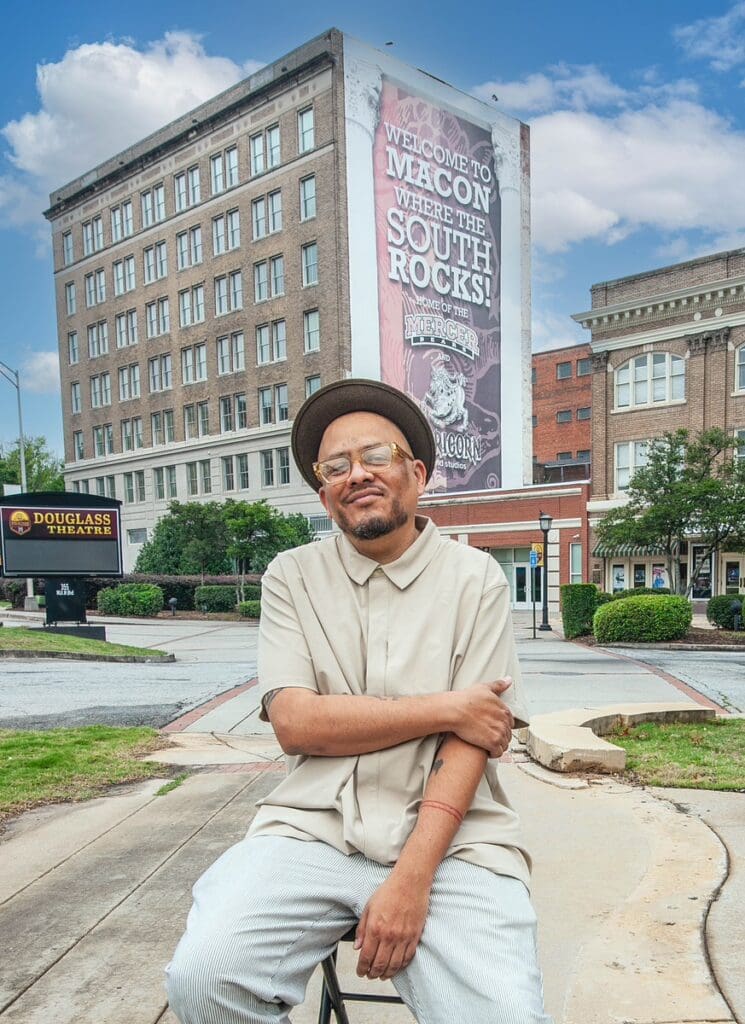
Story by Susannah Cox Maddux | Photos by DSTO Moore
His born name is Aldo Villegas, but his chosen stage and street name is Bocafloja, meaning something like “loose mouth”. As he puts it, it’s “a way to assume a position of feeling comfortable expressing, without restriction, my beliefs.” The Mexico City native turned Maconite — by way of the Bronx — is a poet and rapper of Afro-Indigenous descent who identifies as what he describes as a “cultural worker.” The title is grounded in a tradition of organizing, defying the notion that artistry is often connected to a quest of becoming famous, being hyper materialistic, or detaching from the actual social fabric of one’s community. He’s also one of the 50 most relevant artists of Spanish language hip-hop, according to Rolling Stone and Billboard. He’ll play at Bragg Jam later this summer. So, get to know him before you get to hear him live at Tic Toc.
Tell us who you are beyond your on-stage persona.
I’m a cultural worker; I do different types of art. I primarily work with music, documentary filmmaking, photography, and literature in general. I’m very intentional in understanding my work as part of a larger process — artistic work and cultural work that comes with social responsibility.
What brought you to Macon?
During the pandemic, me and my family, we decided to look for a new location.
I was looking for a space that was more appropriate for growing my family, I wanted to live at a space that was more calm. The South for me represents an interesting space, because the U.S. South for me resembles the Global South as a whole. I was born in Mexico City, which is a huge metropolis. Then moving to New York, there’s a lot of interesting stuff when it comes to living in a huge city like that, but also a lot of impossibilities, and deficiencies, and the rhythm of those cities is completely consumed by certain values that I don’t necessarily subscribe [to].
I believe that I was craving a space in which I could build community from a different angle. Just reshape and rethink about the real meaning of quality of life. Also, in the U.S., there’s a misconception that I constantly face about a lot of people thinking that the U.S. South is regressive, or more conservative, or that it’s not fruitful, artistically. I think exactly the other way around. I think that actually, some of the avant-garde artistically, culturally, or intellectually are coming from spaces in which nobody thinks anything is flourishing, right? So I think for me, it’s more interesting to work in a city like Macon. Because when I was in New York, there’s this pretension of, “Yeah, everybody’s an artist. Everybody’s an activist. Everybody’s this or that.” But here, no one really expects the amazing things that are flourishing in a small city like Macon.
What is the rhythm of Macon?
The rhythm of Macon is like a down-tempo beat. Extra soulful with rich history, and even when rhythm is apparently not visible, I would say it’s colorful. It’s very colorful. It’s very, very rich. It’s impactful. It has a smooth, but constant beat. It is healing. If we make an analogy to music, some people say that one of the most interesting things about jazz music is that it comes with a certain level of imperfection, and for me, that is Macon. That level of imperfection that makes it so unique and makes it so, so alive, so vibrant in a way.
You began to make music in the late ‘90s, right?You’re a director, a writer, you’re obviously a musician, an anti-imperialist. What perspective do you bring to the U.S. and more specifically to Macon?
One of the most important aspects of my work that could be useful is… the process of rethinking topics as identity, migration, race, diaspora. I’m embracing cultural traditions that are in opposition of what is traditionally perceived. Knowing the amount of Spanish-speaking people in the United States, I represent some sort of small bridge that creates dialogues from different perspectives that are non-hegemonic and are not reproducing the same ideas of what apparently being a “Latinx person” is or a “Mexican person” is, right?
I have been able to dismantle some of those notions through art… and particularly in Macon, I believe that I’m slowly trying to build with local Macon artists and create bonds of collaboration that have been helpful to understand how similar we are… hopefully, at some point just to break certain barriers that are inherent in U.S. societies, right?
There [are] very present Black, white, brown divisions, and so on. I think it just goes back to this lack of understanding of how systemically history has been manipulated to keep us separated,right?
I invited one Macon artist to Mexico City to present his work, Kevin “Scene” Lewis. Those types of little attempts to create cross-border dialogues between Macon and other parts of the South — like the Global South, in this case, like Mexico City. The result is quite interesting.
So what about Macon inspires your work?
Macon sunsets are some of the most amazing experiences that I’ve had. It’s the manifestation of visual poetry. There’s so much possibility for storytelling when you walk, or when you pass by or walk through mainly the peripheral areas of the city.
I guess some other small cities in Georgia, for example, are… almost the center of the city is a gas station and a little commercial street. Macon has so much more to offer [with] the historic downtown, but also all those other constructions and all those neighborhoods that with those vivid colors, the contrast, and the possibility of how architecture can share stories and discourse even. It’s really beautiful.
There is an undeniable connection with the community, with the history of the U.S. South, with music itself, with art, and with hope, with a lot of hope. It is a small epicenter that, for me at least, gives me the idea that social change is possible. Social change is going to come from the South. It’s not going to come from the main capitals of the United States. It’s not going to come from Manhattan in New York. It’s not going to come from Hollywood in Los Angeles. It’s going to come from smaller cities that are more in touch with reality, that are more flowing organically.
Is there anything about Macon music that you hear now that feels different?
When we think about rock and roll music as this huge world phenomenon, and not many people know [this]… the historical connection of a guy like Little Richard in Macon. So basically, this is one of the world epicenters of popular music. And of course, what’s the meaning of an icon like Otis Redding for the world?
When walking through Macon downtown, you realize Black music was breeding through those walls. Like, the pillars of Black music and everything that comes after. Because we cannot understand hip-hop music without understanding Little Richard or Otis Redding, or any of those musicians that were part of that movement.
Could you say anything about why Macon chose you? What makes you continue to choose Macon?
I think before moving here, I remember driving by and recognizing that it was a beautiful space. And I believe Macon chose me. I would say it’s a historical reconnection as well. I think it was meant to be because amongst other things, there’s another historical fact that for me is very, very important; there’s the Muscogee homelands in Central Georgia, and the history that is so, so important. And the connection with the Black Seminoles that went to Mexico through the Underground Railroad, escaping, creating autonomous communities in Northern Mexico that are directly connected to my own personal experience.
It’s just a historical passage that I cannot ignore. There’s even a pre-colonial connection between Central Georgia, Macon, and Mexico. I do a lot of work with populations of African descent in Mexico. It is definitely something that impacted me without even expecting it.
Do you have a hope for what your music inspires or how it inspires people?
Even though the lyrical aspect of my music is very important, I always prioritize the musicality, because I believe that music goes into people, or touches people, first through the emotional aspect through their body, not their minds. Maybe the intellectual aspect comes once the music already called your attention and touched your body and soul. I expect to create a connection that even if people don’t necessarily understand everything that I’m saying at the level of the lyrics, they will get the full picture of the discourse, or the intentionality of my music, because of the body language.
So you’ve been touring and working in Mexico and Europe. What is next for you?
I do a lot of academic work. I present lectures at universities all over the place. I write, I do photography, I’m working on some new, short documentaries. I also produce some series of events in Mexico and other places in Latin America. I publish some of my music in forms like vinyl, I’ve done a few books, either photography or short stories or poetry. I’m constantly on the move.
Latin music is becoming more popular in the States. Is that happening and what do you think about that? If somebody says, “He’s like Bad Bunny…” Is there a connection?
I think the phenomenon of Bad Bunny opened up a huge window for people to see and explore and realize that there’s no one-dimensional Latino or Latinx experience… Obviously, it’s beneficial for artists like myself that a guy so visible, so famous and stuff… is actually addressing certain topics that are quite serious, very relevant, in [massive] platforms of visibility.
It brings the opportunity for other artists to show the huge diversity of experiences that can be manifested, or presented artistically, south of the border. So in that sense, I think we can see it as very positive. I think it changed the whole perception and dynamic of — maybe like 15-20 years ago, it was almost unthinkable to hear what is called the U.S. Anglo radio playing music 100% in Spanish, right? It was almost like, “Oh, what is that?” Now that whole dynamic changed totally. It is basically diluted in a dynamic in which language is not defining a social group in particular.
Boca, thank you for choosing Macon. I’ve never been to Mexico City. It’s definitely high on my list, and I need you to be my guide. Can we make that happen?
Yeah, absolutely.