
Story by Lane Richardson
The plan for interviewing Eric O’Dell was simple: meet at the Flying Biscuit Café and talk over a late breakfast. The day of, I got a message:
“Lane, the Biscuit is temporarily closed, forgot about that fire. Can we meet in front of The Hummingbird at 11? I promise it’ll make sense when we meet.”
In another life, I spent my nights making questionable decisions at The Bird, a downtown dive. I haven’t been back in more than a decade, but you only live once.
Eric pulled out a ring of keys. “My wife says I have too many,” he said wryly. Three flights up was his studio, packed with the general clutter of a life spent making art. No AC, but he opened the windows and turned on a fan. I had a list of questions. It never left my pocket. For the next two and a half hours, Eric showed me the Macon that made him.
“When I got to Mercer, I was terrified. I figured I would do my best to be a C student. If I failed, I’d bail.”
Things we take for granted as Maconites made a lasting first impression. “I went to a party at an Orange Street apartment, and just stood at the door with my jaw dropped. I had never seen ceilings this high in my life. I remember the crown molding. I was thinking, ‘Oh my God, you could put a basketball goal in here.’ Florida was all drop ceilings and ranch houses.”
That feeling never really wore off. “I think I was tuned into, subconsciously, that it was a place where stories can happen. Everything was so rooted in the past. Macon felt haunted, in good and bad ways. Just stories in every nook and cranny.”
He compared Macon to trying to draw Venice: “There’s no place where your eyes can rest. You want to draw everything. Macon is like that with stories.”
Even farther back, it seemed like Macon was calling to Eric. “In 1982, before my twelfth birthday party, my dad told me that the mill had closed. He was a colorist. He could look at a swath of yellow and tell the formula and the additives, then say, ‘Mix up this much and run two miles of it.’
“The first job he was offered was in Macon. We were in school, and he had heard the Macon schools were terrible. He couldn’t afford private school. So, they gave the job to someone else. A few weeks later, he was offered a job in the cultural mecca of Panama City.”
The Panhandle became home. There, he met Greta, his high-school sweetheart and future wife. Then Macon got another chance.
“I applied to Florida State and Mercer. The Mercer scholarship was really good, but I think the real reason I came was that it was smaller.
“Mercer was the greatest act of grace in my life. Like every Flannery O’Connor story ever, right? Grace can be hard and hurt you. I got smacked upside the head with the best. The teachers I was fortunate to land in front of made me feel like who I was, was okay and becoming a deeper, better human being in that way was kind of mandatory. Being more of who I was, what I was supposed to do, and Macon was a great place to do that.”
His parents had grown up surrounded by generations of family in the hollers of Virginia. In Macon, Eric says his daughters got something close to that. “They see people at the grocery store that they knew in kindergarten. I never had that kind of continuity.”
“The Odyssey” kept surfacing as he talked about what home meant. “I felt kind of like Odysseus. Always looking for my Ithaca. I had lots of great stories, lost a lot of the crew, but me and Penelope finally landed where the kids are connected. I just feel like that’s grounded them in the world.”
That wasn’t the only place the Odyssey had followed him.
“At the end of the Odyssey, Odysseus goes to see his father. His dad has been sleeping in ashes and leaves and pulling his hair out for 20 years because his son disappeared. He’s going to tell him a bullshit story, and his dad looks at him and Odysseus can’t do it. A sadness goes through him and he says, ‘Dad, it’s me.’
“His dad says, ‘It can’t be you.’ He points to the orchard and says, ‘Dad, we planted these trees.’ He names the trees, and that’s when his dad says, ‘It’s you.’”
During Hurricane Michael, Eric’s father called from Lynn Haven, Florida, inside the eye, terrified. The storm stripped away so much that he couldn’t see a single neighbor’s house. Then the phone went dead. Eric eventually learned that his father was alive and went down to help.
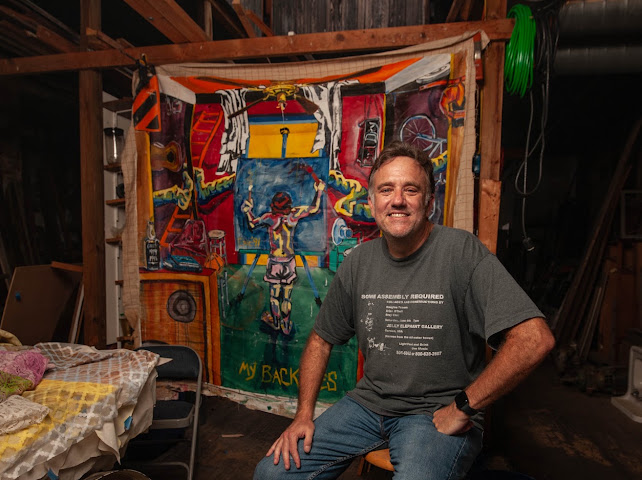
“This painting is my dad’s backyard in Lynn Haven, Florida, ten days after Michael blew through. I called it We Named the Trees. It just hit me.”
Hearing that story standing in front of the painting had my eyes swimming.
History runs throughout his work. Thinking of his father’s work in textiles, Eric began using lace curtains as patterns. “Like Penelope weaving and unweaving the shroud.” His mother, and her absence, can be felt in his art.
“My daughters’ wedding bouquets and table settings, and then my mother through her whole life made baskets. It’s always had a presence to me. I always think of painting as a kind of weaving.”
And yet, he keeps moving forward. “Every brush mark is wrong until the last one.”
Macon was not simply the path of least resistance. There were chances to leave, but they “just didn’t feel right.”
“Having a studio, that’s kept me in town in large part. It’s not what pays all the bills, but I know if I didn’t do it, I wouldn’t be me. Macon has afforded me time and space.”
Is it a good city to be an artist in now?
“There are a lot more opportunities.”
But not ‘yes’?
“Well… at the Arts Exchange, First Fridays had 800 people or something showing up, and I sold the hell out of some work. But I was like a farmer with his turnip truck on the side of the road. I wasn’t in a gallery.
“It’s a great place to be creative. A great place to find your voice. But we’re kind of in a black hole of the visual art world. We need to attract curators and collectors. You shouldn’t have to leave to have success. You can stay here, be rooted and get Macon recognition from more than just the region.”
His solution is simple: pay artists to make art. Eric sees Macon’s tough audience as a litmus test. He came back to the idea through something a writer told him at Mercer.
“It’s like being a gardener. You plant the plants, amend the soil, get them growing. If you’re lucky, the lightning bugs show up. That’s the magic. You can’t control that, only hope for it. If the lightning bugs land on something in Macon, they’ll land on it anywhere.”
Knowing what to do when that magic happens might matter even more.
“Otis Redding, the Allman Brothers, and of course Little Richard, who’s like Einstein, split the atom for music. Now they put billboards up and name sandwiches after him. But during their day, nobody of any official role wanted anything to do with [him].”
While teaching drawing in Paris, an elderly French woman sat next to Eric in a park. She began speaking to him while her grandchildren played. Eric only spoke English. She pantomimed playing a trumpet and pointed to the park sign, identifying the place through the musician it was named for. She tried to ask where he was from.
“Atlanta…?”
Nothing.
“I was like, all right, I am going to do this because it’s all I got. I looked at this old lady, my two kids playing there, and I said, ‘Wop bop a loo bop a lop bam boom!’”
Her face lit up.
“Ah! Petit Richard!”
“I could not believe it. But that is Macon language, right? It might scare the hell out of the sound engineers in the booth during its time, but that is the stuff that is on fire. And we should, as a community, do what we can to feed it oxygen. Space, time, support. That’s what it needs to develop. Because ultimately, people are going to remember ‘wop bop a loo bop’ before they remember a new traffic circle.”