
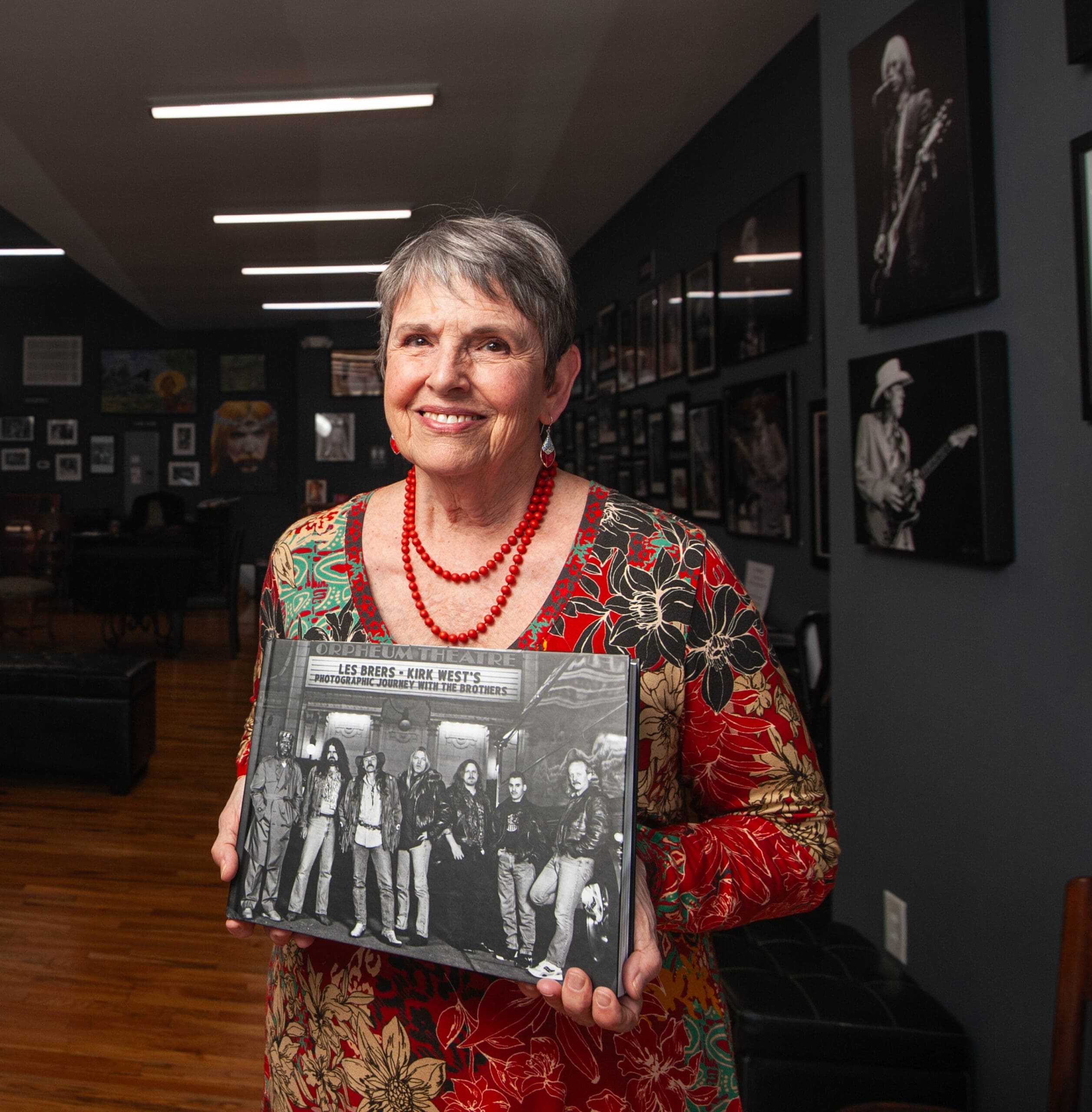
Interview by Haleigh Dearden | Photo by DSTO Moore
This is a continuation of our interview with Kirsten West from the April/May Women’s Issue. In this edition, Kirsten regales us from the beginning on her rock and roll life: Her dream for buying the Big House, her brush with the Capitol Theatre, the start of Gallery West, and leaving a mark on Macon.
What was your life like before Macon?
I’ve had multiple incarnations in one lifetime because I’ve done so many different things. I’m a Midwestern girl. I grew up in Minnesota. I went to college for a couple years, did not get a degree. Then I was a hippie, and I traveled to California. Just on a whim, a girlfriend and I drove out there and we were definitely hippies. I lived in Hollywood from 1968 to 1971 and started out working for an interior decorator in Beverly Hills, who was a famous guy.
Then I decided to move to Canada and lived there for a couple of years, and then moved to Connecticut and got into the insurance business there in Hartford. I had about a 25-year insurance career from Hartford to ultimately Chicago.
I got divorced in 1988 and then I met Kirk [West] in 1991, and he was working for the Allman Brothers Band. I honestly couldn’t name an Allman Brother other than Greg Allman, but I knew a lot about music. Music was my passion, you know, for my entire life. We met in February of 1991 and got married in September, and he was traveling with the Allman Brothers as their tour manager.
Kirk came down here to Macon from Chicago in the fall of 1992. This was before GABBA [Georgia Allman Brothers Band Association], but there was a group that was meeting around the anniversary of Duane Allman’s death. A lot of them were collectors, a lot of them were tapers – where they would tape shows and trade tapes. Kirk came down with the idea of just hanging out with other fans. While he was down here, one of Greg Allman’s best friends, Chank Middleton, told him that he had befriended the family that lived in the Big House.
The Big House was the Allman Brothers home from 1968 to 1971. It was kind of a communal place. Chank told Kirk that he thought he could get a little tour of the house for a selected few number of people. Kirk went through the house with the Leslies. Cedric and Helen Leslie lived in the house. He came home from Macon telling me about it.
What made you decide to take the plunge with The Big House?
He showed me some of the pictures and I just looked at the whole thing and said, “Oh my God, we could have a rock and roll bed and breakfast.” I was ready to do something else. I had a long career in insurance. I could have cared less about it. I just was ready for something new and different.
We made plans to come to Macon in January of 1993. Since the idea was to have a bed and breakfast, we decided to stay at the 1842 Inn just to check out what was a bed and breakfast. Literally at that time, the only bed and breakfast in Macon. There were no Airbnbs. We went through the house, and I was just blown away. I said, “This is an amazing place.” I had some money, and I thought, “Well, let’s have a rock and roll bed and breakfast. Let’s buy this place.”
It needed a new roof. There was no heat or air. It needed a lot, and the appraisal was so low. I thought we could buy the house for what it appraised for, and then the rest we could spend renovating it. Well, the owner had other ideas and said, “I’m not selling this house for anything less than $150,000.” The money that we were going to spend fixing it up, we had to spend putting it down.
Because the house was such a mess, we had to get a construction loan. We set a closing date around the 4th of July. Right away we thought about creating a little archive room. Right off the front entrance to the front door was a couple of rooms that were adjoining, and we put all of Kirk’s memorabilia in there.
Kirk started publishing a magazine called “Hittin’ the Note.” I was the publisher, but he had all the contacts, he had all these fan lists of names and addresses. So I went from being an insurance executive, to publishing a magazine and being like a general contractor for the renovation of the Big House.
Now, the fans started coming to help. We had fans from, oh gosh, Virginia and California that came and said, “I want to help you work on the house.” And they did. They labored. They lived with us. Meanwhile, Kirk is gone, and I was cooking three meals a day for anywhere from six to eight people.
Because the house was in a historic district, we had major issues with what they call the historic review board. We called it the hysterical review board. I had arguments with contractors, and meanwhile, I’m a Chicago businesswoman. I’m not Southern. Kirk and I would play good cop, bad cop with some of these contractors to get them to do what we needed them to do.
Slowly but surely the house needed all new windows, all the floors needed to be redone. We had to have a furnace, we had to have central heat and air put in, and there was knob and tube electric. It didn’t take us long to realize that local planning and zoning laws would not allow us to have a B&B in that house. You would have to put in either a fire escape or a sprinkler system.
Honestly, I thought… We’ll live here for about 5 years and then we’ll move on. We’ll go somewhere else. We love New Mexico, New Orleans. I did run out of money. A friend of ours suggested that we create a non-profit and raise money and turn the house into a museum.
Kirk, through his amazing connections in New York City – because the Brothers would play in New York City every March for two to three weeks at the Beacon Theatre – these Wall Street guys who were all multi-millionaires just picked up the ball and ran with it to help us raise money for the museum.
We raised several million dollars in a couple of years. We formed a nonprofit, the Big House Foundation, and it didn’t take long. So the work began again. We had designers come in and figure out how to do the displays. We got in-kind contributions from local contractors here in Georgia.
Once the house was nearing completion, we tried to decide where we were going to live. Initially, I thought we would leave Macon. Kirk could still work for the Allman Brothers from anywhere in the country. We looked at houses in New Mexico and we actually made an offer. We ended up selling the house to the Big House Foundation. Kirk had all this memorabilia that he owned. It was appraised for several million dollars, and we donated most of that to the house. But I did want the Big House Foundation to literally pay us for the house.
The thing in New Mexico kind of fell through, and the Big House Foundation wasn’t prepared yet. They hadn’t worked through all of the paperwork and everything. In the meantime, I thought, I don’t want to be that far away from my son and his family. We started looking in Athens and up in Asheville and Blowing Rock and some other places in the South. Then we had a friend who was thinking about moving up here from Miami.
I was driving his wife through Macon to show him some different beautiful neighborhoods and we drove through Shirley Hills, and I saw this darling house with a “For Sale By Owner” sign. I backed up and I wrote down FSBO.com and the number, and I went back and told Kirk, “We have to get into this house right now.” We fell in love with this property, and I said, “If we can buy this house, I’ll never leave Macon.” I’m here forever. This is it.
How did you take a turn at the Capitol Theatre?
I was working in conjunction with the Big House Foundation, and they ended up hiring me as director. I didn’t do that for very long, but I did raise some money and plan a huge, huge party. We had 450 to 500 people, and I had the biggest tent you could get. I was still publishing the magazine, which was labor intensive, and I mean, I would stuff envelopes and do all that.
When we moved into Shirley Hills, I thought I should get a job. I found out that the Cox Capitol Theatre – that’s what it was called then – was looking for a director of development. At the time, I know that Julie Wilkerson ran it for a while and then when she left, Tony Long was there and he was running it. They hired me to raise money for the nonprofit, but I realized that the theater wasn’t viable. There were no regular concerts there.
I just said, “Look, I can’t raise money for an organization that isn’t doing anything.” I started booking acts. I had a wish list with all these rock acts and country acts, and I literally put that place on the map. We’d have a big show and because it was a nonprofit, I would sell tables down front to these shows, $1,000 a table. I very rarely even took a salary.
Probably the first really big show I did was Travis Tritt. I had Chuck Leavell do a show there. I had Lucinda Williams, Marty Stuart. I knew what I was doing because I would go out on the road with Kirk sometimes. He was a tour manager; you would make sure everything was set up right for the band. Basically [at The Capitol], I was a promoter. Promoters sometimes don’t treat the acts very well. I made sure that there were good meals for the bands, and everything was set up with everything they needed.
I can take a lot of pride in that I really turned that place into a business, but I was cleaning toilets and a lot of times there wasn’t any money. Kirk and I had planned a trip to Europe, and he said, “You’re quitting.” I started taking antidepressants. It just drove me crazy, and I thought, “Well, I’m not depressed. I’m just overworked.” I got off the antidepressants, but he said, “You’re not going back there when we come back from Europe.”
When I left, they had to hire people. The guys like Tony Long Sr., Wes Griffith, David Thompson, and I think maybe Josh Rogers helped. Oh my God, I loved Josh so much. When I needed help at the theater, Josh was amazing. He would show up and sit me down, because there is a lot of stuff I really didn’t quite understand.
Museum, theatre… how did you reincarnate again to form an art gallery?
I quit and Kirk quit. He retired from the road, and we started traveling a little bit. One of his friends from Baltimore suggested that he take his photography and go to some hippie festivals, you know, jam band festivals.
As long as Kirk and I were married, he would show me his photography. That wasn’t what he was doing when he was working for the Allman Brothers, but they were his subject matter, for the most part. I didn’t even know he had all this. Then he decided to do his book, it’s his 40-year photographic memoir of his time spent with the band.
After the last one of those festivals we thought, let’s do a pop-up gallery. This was in 2015, okay? Downtown Macon was not that exciting. It was starting to be rebuilding. We looked at a bunch of space that was empty downtown and we saw this space. They had laid the floors, and that’s about it. I think they put the drywall up, and Diana Blair, who owned Blair’s Furniture across the street, got here and looked at the space. My idea was, let’s have a pop-up gallery and do this for the Christmas holidays. Sell a few books, sell some pictures and call it a day.
I just thought we would do this for a few months, and that was 10 years ago.
Diana said, “Well, it’s not going to be ready for Christmas.” But we still love the space, and we decided, let’s hang in there. We had a soft opening in January of 2015. Kirk’s books were delivered there on big pallets. He did a Kickstarter to raise money for the books. We had teams of people stuffing the books into boxes. We shipped them out all over the world. We had live music over there. We had other photographers come and we would exhibit them over there. We, of course, started having First Friday events. Our first lease with her was like, six months long. So here we are, and now we just celebrated 10 years.
Like I said, I’ve had multiple incarnations, the insurance world, the Big House world, being a publisher of a magazine, taking over the theater, and then, you know, starting a gallery. But yes, Macon chose me. Yes, it definitely did. But it’s really more like I chose Macon, because it was my idea to come down here. It was my money that bought the house.
If we hadn’t done the Big House, I don’t think anybody would have done anything with Capricorn Studios. In the 14 years we lived there, we probably had about 20,000 people come even before it was a museum. We had these archive rooms set up, and people would come in and we never charged admission. We had a little box that says “Lord loves a grateful giver” on it and people could donate if they wanted to give. When we created the museum, then they really started coming.
There’s a lot of things that probably wouldn’t have evolved the way they have in Macon had Kirk and I not come down here and bought that house, and I’m proud of it.
Now I’ve been here for 32 years, and I have watched Macon evolve into something. It became a place I want to live in.