
Story by Sarah Gerwig | Photos by Susannah Maddox, Katie Powell
At 16, most teenage boys are practicing for their driving tests, thinking about high school graduation, dreaming of the future. In the spring of 1995, all this was true for Shareef Cousin (pronounced COO-san, with a New Orleans drawl). Or it was true, until a wrongful conviction sent him to death row — the youngest death row prisoner in Louisiana history and among the youngest in the modern era.
Shareef had been playing youth league basketball across town in Tremé when the crime took place. The game was recorded on video and time-stamped. He was innocent. But it would take years before he was exonerated. So he grew up on death row, separated from friends and family.
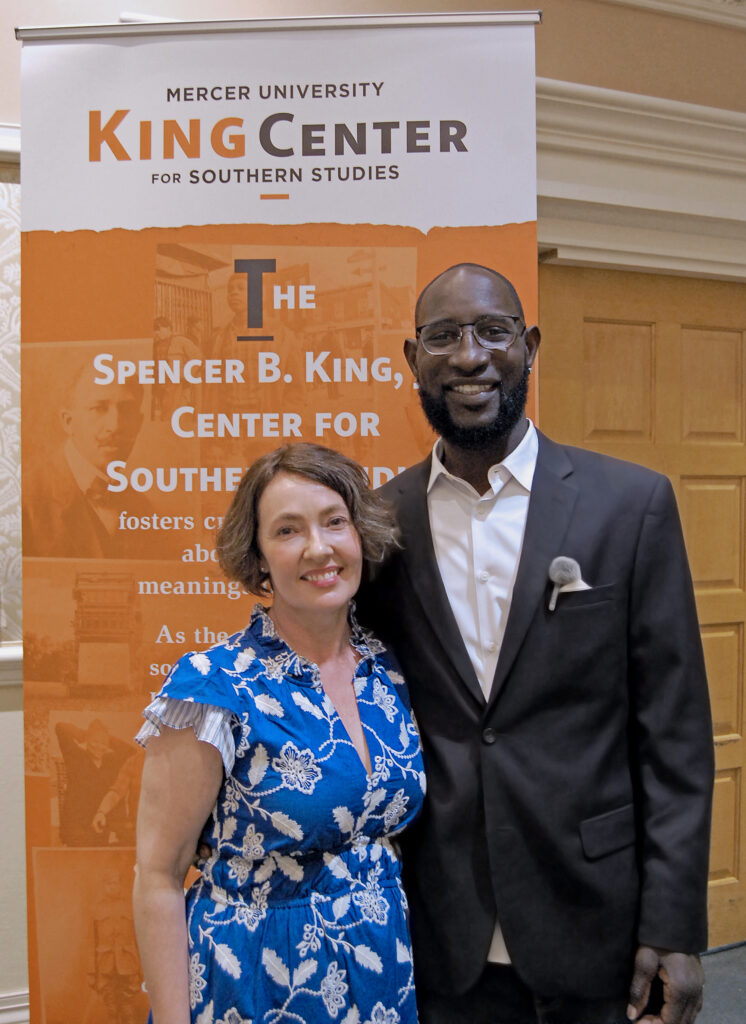
This past April, Shareef Cousin spoke about this to a packed, rapt room at Mercer University, describing what happened in courthouses and prisons decades ago and how it reverberates today. His talk was sponsored by the Spencer B. King, Jr. Center for Southern Studies, which aims to “foster[] critical discussions about the many meanings of the South.”
Cousin is exploring these “many meanings” for himself, traveling around the country in an RV with his youngest sons, witnessing America together. And telling his story.
Cousin shared further reflections in a later interview with Macon Magazine, edited lightly for length.
Does it dredge up painful memories every time you tell your story publicly?
Some days I can tell my story with strength and courage. Other days, one question takes me right back to being a sixteen-year-old kid sitting alone on death row. Trauma doesn’t disappear just because time passes.
What do you hope people learn from your story?
I want people to understand that justice is about people, not statistics.
I want future lawyers, judges, and policymakers to remember that every case file represents a human life. I also want people to understand trauma. Prison doesn’t just punish people — it changes how we think, trust, and make decisions long after we are released. I also want people to leave believing in redemption, healing, and the power of second chances.
What do you say to people who think the criminal legal system generally functions well, but just makes some occasional mistakes?
Mistakes happen in every profession. My case wasn’t just bad luck. Every wrongful conviction usually has human decisions behind it — whether that’s mistaken eyewitness testimony, withheld evidence, inadequate defense resources, or misconduct. If we believe these are simply unavoidable accidents, then we stop asking how to prevent them.
How are you taking care of yourself and coping with the continuing trauma of what you’ve lived through?
Healing isn’t a destination for me. It’s a daily practice.
Being a father has probably saved me more than anything. My kids give me a reason to keep growing and keep living. Trauma is like a cancer. It eats at my thoughts daily.
Traveling the country in our RV has become part of my healing. Instead of letting prison define my world, I’m introducing my sons — and myself — to places, people, and history I never imagined I’d experience.
I also lean on faith, trusted friends, and meaningful work.
What has been the inspiration for wanting to travel with your boys?
I never had my father in my life. All my childhood, I saw other kids with their father and I always wanted a relationship with mine. I searched for him. When I found him years later, he denied me in my face. I was 11.
On death row, he never visited, wrote me or even acknowledged me. When I was on death row, I made myself a promise.
If I was ever given another chance at life, and if I ever became a father, I would be present. This trip isn’t just about seeing America. It’s about giving my sons experiences instead of excuses. I want them to understand our country’s beauty, its history, its failures, and its possibilities.
What are the challenges today?
The biggest challenge has been uncertainty. Honestly, I’ve been rationing food. As I write this, my sons’ cell phones have been disconnected because I can’t afford the bill.
But the greatest joy has been watching my boys experience life through curiosity instead of fear. They’ve stood on the Edmund Pettus Bridge during the anniversary of Bloody Sunday. They’ve listened to stories of civil rights leaders. They’ve watched me speak about my story at Mercer. We’ve laughed around campfires, cooked together in an RV, and talked for hours while driving down highways.
Ten years from now, I don’t want them to remember the RV or their cell phones being disconnected or eating ramen noodles for lunch every day.
I want them to remember that their father showed up. I was there for them… I hope they remember a man who kept his promise — that no matter how difficult life became, I chose to be present.
Sarah, I want to close by saying people often look at me with amazement because they read about a child surviving death row. People view me as this strong, amazing man. People ask me how I survived death row and can still be positive. The truth is, surviving death row was only the beginning. The harder journey has been learning how to truly live after freedom. That’s the journey I’m on now — and I’m inviting my sons to walk it with me. I pray and hope I can survive this chapter too.