
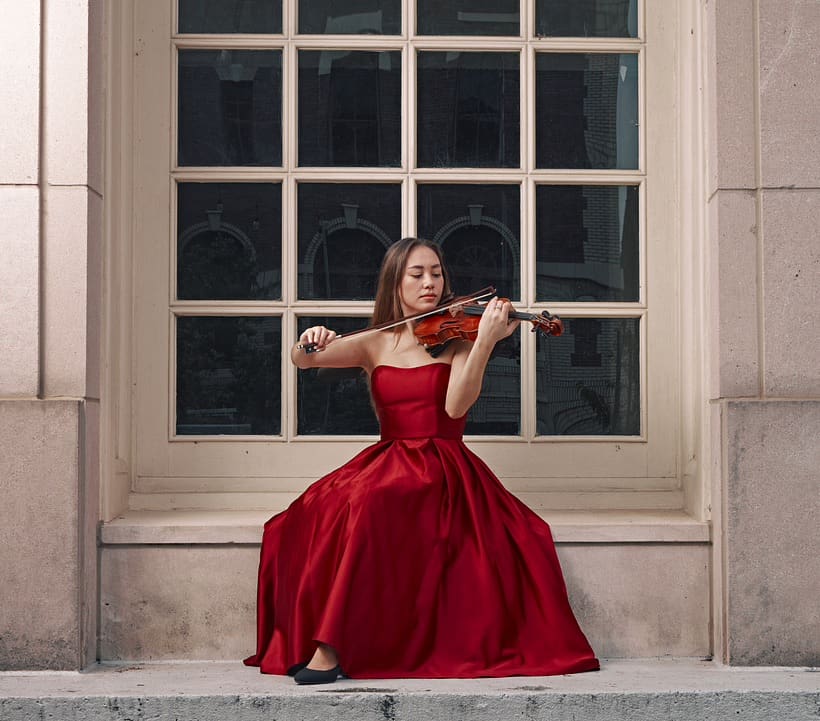
The Robert McDuffie Center for Strings celebrates 20 years — with big surprises and new faces on the horizon.
Story by Michael W. Pannell
Twenty years ago, a handful of eager young students stepped into the first sessions of the Robert McDuffie Center for Strings at Mercer University — the beginning of what would become a world-class concentrated program with an international reach and reputation. What started as a bold idea from one of the world’s great violinists (and a proud Macon native) has grown into a singular training ground for serious young musicians from the Southeast and far beyond.
“Two decades ago, world-renowned violinist Robert McDuffie brought a revolutionary vision to life at Mercer University — a unique conservatory experience that blended artistic excellence with the practicality of a liberal arts education,” said Mercer University President Penny L. Elkins. “Today, the Robert McDuffie Center for Strings is one of the most prestigious and internationally acclaimed centers in existence. It is a legacy we carry with tremendous Mercer pride, and one that continues to prepare exceptional musicians not just for careers, but for meaningful lives of service to their art and their communities. Bobby’s unwavering commitment to the Center and to our Mercer students remains as vital today as it was at its founding.”
Beginnings
Robert McDuffie’s musical gifts carried him from Macon to New York’s Juilliard School while still in his mid-teens, and then into life as a Manhattan-based, internationally celebrated violinist. Yet he never lost his affection for his hometown. So, when then–president of Mercer R. Kirby Godsey asked him in the mid-2000s to carve out time from his global touring schedule to teach, McDuffie quickly agreed.
Soon after, Godsey asked McDuffie for something larger: to create something remarkable at Mercer. The request required more time, more imagination, and more entrepreneurial energy — and again, McDuffie said yes. What that “something remarkable” would be, however, wasn’t yet clear.
“What Kirby did was tap into my love for Macon; that’s how he got me,” McDuffie said. “Before I ever set foot inside a music building, his strategy was to use my love for my hometown. I didn’t know how universities worked or a lot about Mercer, and I had no idea what we would do, but I agreed.”
The idea came together soon enough.
“Sitting on the Mercer campus, it hit me what it would be and what it would take,” he said. “We needed to create a center for strings — a center of the highest quality, all about strings. Why not create something here for highly talented string students from Georgia and all around the Southeast? When I was young, I had to travel to New York to find the level of instruction I needed, and I knew of others from the Southeast who’d been in the same situation. Why not fill that need and create something closer?”
Godsey embraced the vision. Knowing he had a mandate, McDuffie began recruiting renowned players — many from the Atlanta Symphony Orchestra, and some from prestigious ensembles around the U.S. — who would travel regularly to Macon to teach and mentor students. Though for many it meant traveling long distances, the response was enthusiastic.
In 2006, the first two students began their studies.
The center, which is accredited as part of Mercer’s Townsend School of Music, eventually found its home in the Bell House on College Street, an 1855 antebellum mansion listed on the National Register of Historic Places. Renovated with practice rooms, teaching studios, a performance space, and modest offices, the intimate space became a conservatory-quality environment on par with some of the best music programs in the country, yet with its Southern character and charm intact.
Students and Structure
From the start, the Center capped enrollment at 27 undergraduate students. Each accepted student receives a full tuition scholarship. They represent the full range of orchestral string instruments, studying with visiting faculty, called distinguished artists, who are active, proven, high-level performers such as David Kim, concertmaster of the Philadelphia Orchestra.
Small numbers ensure personal mentorship. Alongside their regular instruction, students can schedule additional time with McDuffie and other instructors and musicians visiting for one-off, special events.
Violin student Benjamin Linton said the access is transformative.
“I think one of my biggest learning opportunities at the Center is playing with these incredible musicians,” Linton said. “Before I came here, my teachers were awesome, but they weren’t at the level we have here. Learning from a teacher at this level of accomplishment and even stardom on a constant basis is such a great experience — so meaningful.”
“Not only that, getting to see how they themselves practice in the prime of their careers, how they handle problems they encounter with a piece or performance and work hard to perfect their playing, is enlightening. Usually, some teachers are just focused on teaching and pedagogy. We get to learn from amazing performers, each with their own ideas about music, performing, and what it takes to be a great musician.”
Beyond musicianship, the Center emphasizes the entrepreneurial skills essential for today’s working artists. Its primary degree is the Bachelor of Music with Electives in Business — a deliberate pairing.
“Being part of Mercer allows our students to take advantage of a liberal arts education and learn business skills,” McDuffie said. “Musicians are creative, smart, capable, and innovative, but they need a head start learning the ins and outs of business, which they will have to learn on their own in the world if they don’t get it here. And we’ve seen the fruitfulness in our graduates.”
Students take courses across the university like English, art, psychology, and theatre as well as microeconomics, accounting, leadership, professional selling, social media marketing, and hospitality. This is all while practicing incessantly, preparing recitals, and performing.
Results
The results speak loudly. Students regularly continue to elite graduate programs — the Curtis Institute of Music, Cincinnati Conservatory of Music, Indiana University, The Juilliard School, and others. Alumni hold positions in major orchestras, including first violin with the Berlin Philharmonic, principal bass with the Helsingborgs Symfoniorkester in Sweden, and principal violin with the San Francisco Symphony.
Following their entrepreneurship training, others have launched their own chamber groups, festivals, and nonprofits such as the Hawaii Chamber Music Festival and the Nashville Chamber Music Society.
Still others are forging freelance careers or producing their own podcasts. One current student, Kathryn Fakeley, founded Open Strings locally here in Central Georgia, a nonprofit that brings music to places like schools, nursing homes, hospitals, and Macon’s Daybreak Resource Center for people experiencing homelessness. She is determined to bring live music’s inspiration and healing power to places where it’s not heard.
None of this, McDuffie notes, would be possible without the leadership of former artistic director Amy Schwartz Moretti, who left the Center this year, and the many Mercer faculty, staff, and community members who have helped shape the program. McDuffie himself continues to model the blend of artistry and entrepreneurial drive he expects of his students, having founded not only the McDuffie Center but the Rome Chamber Music Festival in Italy and other ventures.
Next issue: A closer look at how the Robert McDuffie Center for Strings creates opportunities for students — and the community — and how it is poised to make the next 20 years brighter still.