
What transportation means for Central Georgia’s future
Story by Weston Stroud | Photos by Matt Odom
Over the past year, Central Georgia has experienced one of its strongest years of investment in walking, bicycling, and public transportation. Across Macon-Bibb County, new sidewalks have been built, bicycle facilities expanded, bus stops upgraded, and public spaces transformed.
At first glance, these appear to be routine infrastructure projects, and they certainly don’t always make the news. But they reflect a much larger conversation taking place across America about what transportation is for, who it serves, and ultimately, who should pay for it.
This year, Macon-Bibb County completed nearly three miles of new sidewalks through three major projects. Barrington Hall added 14,402 feet (2.11 miles) of sidewalk, Hollingsworth Drive added 3,000 feet (0.57 miles), and Pine Hill Drive added 1,600 feet (0.30 miles). These sidewalks improve access to neighborhoods that previously lacked safe pedestrian infrastructure. At the same time, nearly 100 Americans with Disabilities Act (ADA)-compliant curb ramps were installed or upgraded through county and state projects, making streets more accessible for seniors, people with disabilities, parents pushing strollers, and anyone traveling on foot.
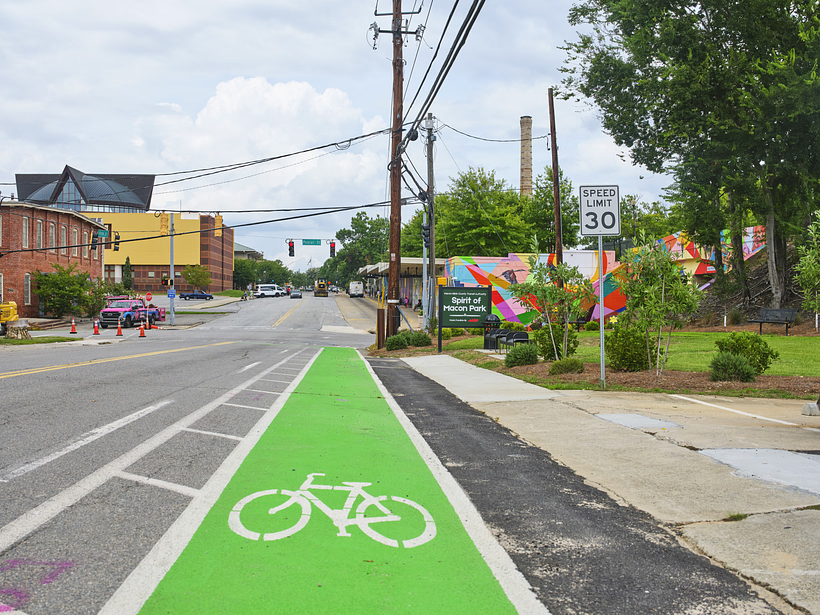
Bicycling infrastructure also saw one of its largest expansions in recent years. The county added 0.6 miles of bike lanes on Montpelier Avenue between Pio Nono Avenue and Johnson Avenue, 0.9 miles on Roff Avenue between Bartlett Street and Brookdale Avenue, and 5.6 miles along Sardis Church Road from Frank Anderson Parkway to Avondale Mill Road.
The Macon Transit Authority also incorporated approximately 600 feet of bicycle facilities as part of the new Spirit of Macon Park adjacent to the Transfer Station, strengthening the connection between downtown, public transit, and the Ocmulgee Heritage Trail. Shared lane markings were also added along portions of College Street and Forsyth Road, continuing to build a more connected network for cyclists throughout the community.
Public transit continued a trajectory of upward momentum as well. Fixed-route ridership increased from 574,019 passenger trips in 2023 to 676,821 trips in 2024, before reaching 726,841 trips in 2025. This increase demonstrates growing confidence in the system and increasing demand for reliable transportation options. Paratransit service remained steady at more than 42,600 trips annually, providing essential mobility for residents who have disabilities and others who rely on accessible transportation.
Macon Transit Authority also launched its new microtransit service, upgraded 11 bus stops with new passenger shelters, began installing electric bus charging infrastructure to support a cleaner fleet, and transformed a vacant lot beside its Transfer Station into Spirit of Macon Park, meant to be a welcoming public space that improves bicycle and pedestrian connections while creating a stronger gateway into downtown. Together, these investments add up to more than isolated projects; they demonstrate a true commitment from Macon-Bibb to creating a transportation system that serves residents of all ages, abilities, and income levels.
These accomplishments improve quality of life, but they also raise an increasingly important question for citizens.
WHO PAYS FOR MOBILITY?
For much of the last century, Americans generally accepted transportation as a public good. Roads, bridges, sidewalks, and public transit were viewed as shared investments that connected people to jobs, schools, healthcare, businesses, and one another. Connectivity and community was a clear value.
Today, however, many of the same debates surrounding public education have begun to influence transportation policy.
“Why should I pay for schools if I don’t have children in them?”
“Why should I pay for buses I don’t ride?”
“Should users simply pay for the infrastructure they benefit from?”
“Why should my taxes fund sidewalks I don’t use?”
“Should users pay directly?”
In recent years, there has been a shift toward viewing public services through the lens of individual benefit rather than collective investment. That tension is likely to shape conversations about schools, transportation, and local government for years to come.
Which way should we shift? Should road improvements shift to the ideological framework applied to public education, where users pay directly?
What role does our government play? And at what point do we accept monetary responsibility for transportation improvements?
These are complex questions, particularly as housing costs and property taxes continue to rise. Retirees and homeowners living on fixed incomes understandably worry about affordability, while others believe the government should play a smaller role in connectivity improvements and that transportation users should bear more of the direct cost of the services they consume.
“Even residents who never board a bus benefit when more people have access to employment and essential services.”
Where does collective investment end and individual benefit begin? There was a time in Macon-Bibb when our policy required that the people making requests had to fund the road improvements they sought, and Macon-Bibb simply oversaw the process.
With the advent of Uber, Lyft, Waymo, and other transportation options, more people are choosing alternative means of transportation in order to avoid the cost burdens of owning a personal vehicle. Why should their taxes go to street improvements instead of sidewalk improvements?
Transportation planners often use a quarter-mile radius for transit access, a half-mile radius for pedestrian access to destinations, and the concept of a “10-minute neighborhood” (roughly a half mile radius) as a benchmark for walkability. Should all sidewalk improvements be placed solely on those within these half mile areas? If so, does this contradict affordability concerns for retirees and those on fixed incomes? In neighborhoods where sidewalks are not present, should homeowners have to pay for sidewalks to be added? Some would suggest that they purchased a property knowing the conditions of the neighborhood — so why is it now the government’s responsibility to address the issue?
As local governments struggle with aging infrastructure, limited budgets, and changing demographics, these questions will only become more common.
TRANSPORTATION IS CHANGING
The transportation marketplace itself has changed dramatically. There was a time when simply adding more travel lanes was considered the solution to congestion. Communities competed for highway expansions because more pavement was assumed to mean less traffic.
Today, we understand the picture is more complicated.
Transportation functions much like a marketplace. When congestion increases the “cost” of a trip, people seek alternatives that reduce that cost. Time functions much like money.
Increasingly, those alternatives are not just different roads to travel. They include Uber, Lyft, bicycles, telework, home delivery, microtransit, and emerging autonomous vehicle technology. Many younger adults are delaying car ownership, while many older adults are looking for ways to remain mobile after they stop driving.
If more residents choose not to own a vehicle, should transportation dollars continue to focus almost exclusively on expanding roads? Or should greater investment go toward sidewalks, transit, and bicycle infrastructure that supports multiple ways of getting around?
TRANSIT MATTERS (EVEN IF YOU NEVER RIDE IT)
Public transportation has never been justified simply because everyone rides the bus. The value of connectivity comes from the opportunities it creates.
Transit connects people to work, healthcare, schools, grocery stores, and recreation. It provides independence for seniors who no longer drive, teenagers who cannot yet drive, people with disabilities, and workers whose jobs depend upon reliable transportation.
Even residents who never board a bus benefit when more people have access to employment and essential services. Businesses benefit from a larger workforce. Families benefit when transportation costs decline. Congestion can also be reduced when people have meaningful alternatives to driving.
The question is not whether everyone rides transit. The question is whether everyone benefits from living in a community where mobility exists.
SAFETY IS DIFFERENT THAN CONGESTION
These funding discussions become even more important when viewed through the lens of safety.
Although total crashes in Macon-Bibb County have generally declined over the past several years, pedestrian crashes remain a significant concern. In 2025 alone, the county experienced 105 pedestrian crashes, resulting in 74 pedestrians injured and 12 pedestrian fatalities. Behind every number is a family whose life changed forever when their loved one was hit.
Congestion is frustrating. Traffic deaths are permanent.
Historically, transportation engineering emphasized moving as many vehicles as possible as efficiently as possible. Today, engineers are increasingly challenged to balance mobility with safety.
The research is clear: wider roads often encourage faster driving, and higher speeds dramatically increase both the likelihood and severity of injuries when crashes occur.
That is why modern transportation planning increasingly focuses on the concept of “Complete Streets,” which means planning safer crossings, traffic calming, better lighting, accessible sidewalks, and bicycle facilities simultaneously to adding any traditional roadway improvements.
The goal is not simply to move cars fast on roads. It is to move people to where they need to go safely.
UNDERSTANDING LOCAL CONTROL
Another challenge often overlooked is that many roads residents think of as “local streets” are actually state roads, maintained by the Georgia Department of Transportation.
Corridors such as Riverside Drive, Vineville Avenue, Pio Nono Avenue, Gray Highway, Emery Highway, Mercer University Drive, Broadway, Martin Luther King Jr. Boulevard, Spring Street, Walnut Street, Shurling Drive, Hawkinsville Road, Jeffersonville Road, and Ocmulgee East Boulevard are all state highways.
Although Macon-Bibb County frequently maintains traffic signals, pavement markings, landscaping, and performs routine maintenance, significant changes such as lane reductions, medians, bike lanes, or pedestrian crossings generally require coordination with and approval from GDOT. This means improving safety is often a shared responsibility rather than a decision made solely at the local level.
GETTING TO OUR DESTINATION
The discussion about transportation eclipses just buses, sidewalks, and pavement. It raises one of the defining policy questions communities across America will face over the coming decades.
If transportation is no longer viewed primarily as a collective investment, what becomes the responsibility of the individual, and what remains the responsibility of the public?
Should homeowners fund sidewalks adjacent to their property? Should transit riders pay the full cost of operating buses? Should drivers alone pay for road improvements?
REASONABLE PEOPLE CAN DISAGREE
But one principle should unite us regardless of ideology: every resident deserves the opportunity to reach work, school, healthcare, church, parks, and home safely. Transportation is ultimately not about asphalt or concrete.
It is about opportunity. It is about independence. And, most importantly, it is about ensuring that everyone in Macon can move through their community safely, regardless of how they choose to travel.
Weston Stroud is the traffic safety manager for Macon-Bibb.
Get involved with pedestrian safety by following the Pedestrian Safety Review Board and Bike Walk Macon.