
There’s been two decades of progress in Macon’s urban core. Now, change is creeping towards the river and over to the East side of town. Here’s why many major improvement projects are converging on one fateful spot. What do Maconites think?
Story by Brittny Johnson | Photos by Matt Odom
For the past several years, anyone traveling through downtown Macon has likely encountered orange barrels, detours and construction at the I-16/I-75 interchange. The Georgia Department of Transportation’s (GDOT) project is designed to improve safety and mobility by adding lanes, widening shoulders, improving access ramps and creating safer pedestrian connections. The long-term goal is to reduce congestion while making it easier for commuters, visitors, and businesses to move through the city.
It’s been a long time coming. But the project, which began the final stage of construction in late 2025, is finally progressing.
For Scott Mitchell, a downtown business owner who lives on Macon’s East side, the redesigned interchange represents one of the biggest opportunities in decades. “I’ve been so excited about this I-16/I-75 project,” Mitchell said.
“When you get off the interstate now, you pour right into the heart of downtown Macon. You could not ask for a better opportunity.”
Mitchell believes the new downtown exit fundamentally changes how visitors experience the city. Instead of weaving through streets after exiting the interstate, travelers will immediately know they’ve arrived in Downtown Macon.
For local businesses, that visibility could translate directly into more customers and stronger economic vitality, Mitchell adds.
The interchange is just one part of a broader transformation along the Ocmulgee River that includes a new arena, Mercer’s medical school building, Bicentennial Park, a new convention center, the East Bank mixed use development, and the proposed redesignation of Ocmulgee Mounds as a national park. It’s a lot of change in a small, walkable area.
Together, the projects are expected to attract tourism, greater investment, and new economic opportunities further afield from where Downtown Macon’s development had centralized, over into the east side of town.
Mitchell understands the frustration and growing pains residents may feel during times of change, but for him, the inconvenience has always been temporary. Those seemingly small improvements represent something much larger: thoughtful infrastructure that improves everyday life. Paul Bronson, Macon-Bibb County commissioner for District 2, which covers part of this area, agrees.
“We are in a historic period of momentum and transformation that will benefit future generations,” Bronson said, “and with any major development comes doubt, uncertainty and skepticism… and that’s okay. The construction may be an inconvenience today, but the long-term benefits will be significant for our residents, business owners, and those traveling through our community.”
For Dominique Johnson, pastor of Kingdom Life Church in East Macon and executive coach, growth is necessary, but only if it benefits everyone.
“As long as it’s changing for the betterment of everybody, not just change where only a few people can profit,” Johnson said. “We have to constantly evolve and be up to date with current times and what’s going on.”
Johnson believes Macon has every reason to celebrate its progress but cautions that economic development must be paired with intentional investment in the people who need it most. He points to Macon’s poverty rate — roughly 25 percent, about double the national average, as a reminder that infrastructure alone cannot solve every challenge.
“Hopefully this helps with the transportation and logistics industry,” he said. “But we still need to think about how we help the least of these be equipped and empowered so they can flourish as well.”
His perspective reflects a broader conversation happening throughout the city. While many residents are enthusiastic about new developments, others are asking whether those investments will extend beyond the city center.
“For too long we’ve been either/or. We have to figure out how to do a both/and,” Johnson said.
Mitchell shares Johnson’s belief that growth should be inclusive, even as he remains optimistic about the city’s progression. While he sees overwhelming excitement among the people he interacts with daily, he also recognizes concerns about affordability.
“We want to make sure that as we grow and become more accessible, we’re making this for all people, and not just people of a certain tax bracket,” he said.
Serving on the OneMacon Panel gave Mitchell a firsthand look at conversations happening behind the scenes. He says leaders are intentionally discussing affordable housing, neighborhood preservation, and equitable development before projects begin rather than after problems arise.
“It’s a very hard job,” he said. “If you’re lucky enough to get into the room, then it’s your responsibility to help amplify the voices that may not be there.”
Mitchell believes there’s still room for improvement, particularly by including younger residents and those from lower-income communities in conversations that will shape Macon’s future. “We’re making decisions for the next generation,” he said. “Why are their voices not in the room sometimes?”
Johnson is optimistic about projects like the Ocmulgee Mounds redesignation and the new arena, believing both have the potential to raise Macon’s profile and strengthen tourism and commerce. Yet he believes the city’s greatest success will be measured not only by the number of visitors it attracts, but by how well it serves its own residents.
“How does it spread to the neighborhoods? How does it get into Fort Hill, Tindall Heights, Pleasant Hill, and those areas?”
His hope is that today’s investments create opportunities that spread throughout every corner of Macon. “So let me be clear,” Johnson said. “I think there is a buzz. I just want there to still be the intentionality for the whole pie to grow.”
That sense of momentum is something Mitchell also feels. Having lived in much larger metropolitan areas, he believes Macon’s size gives it a unique advantage.
“In a city like Macon, you know the people who are going to be affected by the decisions you’re making,” he said. “I’ve seen people reach across political lines and work together because they know this is good for the community.”
Johnson believes leadership will play a critical role in determining whether today’s momentum becomes lasting progress. “I hope the right people are at the table,” he said.
Mitchell agrees that the opportunity before Macon extends far beyond new roads or buildings.
He imagines a future where families no longer drive to Atlanta for every major concert, conference, or sporting event, where visitors exit the interstate directly into downtown, and where local businesses thrive because more people are choosing to spend time and money in Macon.
“I know for a fact people don’t truly understand the economic impact to local businesses,” he said. “If we can increase the amount of business, we can pay our people more. We can expand. We can grow.”
For Mitchell, that’s what makes the changes worth enduring.
“Sometimes it feels like these projects have been dangled in front of us for years,” he admitted. “But I still have hope.”
Mitchell sees opportunity in new customers and thriving local businesses. Johnson hopes investment reaches every neighborhood. Bronson believes lasting progress depends on transparency and community trust.
Their perspectives differ, but they share a common belief: Macon’s future isn’t defined solely by roads, arenas, or new buildings. It will be measured by whether today’s investments create opportunities for everyone.
“Lasting progress requires community buy-in,” says Bronson. “Concerns can be addressed through clear communication and transparency, and a shared vision for where we are headed as a city. Real leadership starts at the top, but lasting success is built alongside the people we serve. We are Macon-Bibb.”
If that happens, Macon won’t simply be building a better city, it will be building a stronger community.
Breaking ground and building the next generation of memories
Before the lights go up on opening night, Macon’s new arena is already telling a story.
By MM Staff
For 60 years, the Macon Coliseum has been where Central Georgians came together. It has hosted state championship victories, legendary concerts, graduations, trade shows, hockey games, and countless first-time experiences to big events that turn into core memories. Now, nearly a lifetime after opening its doors, the venue is preparing to pass the torch.
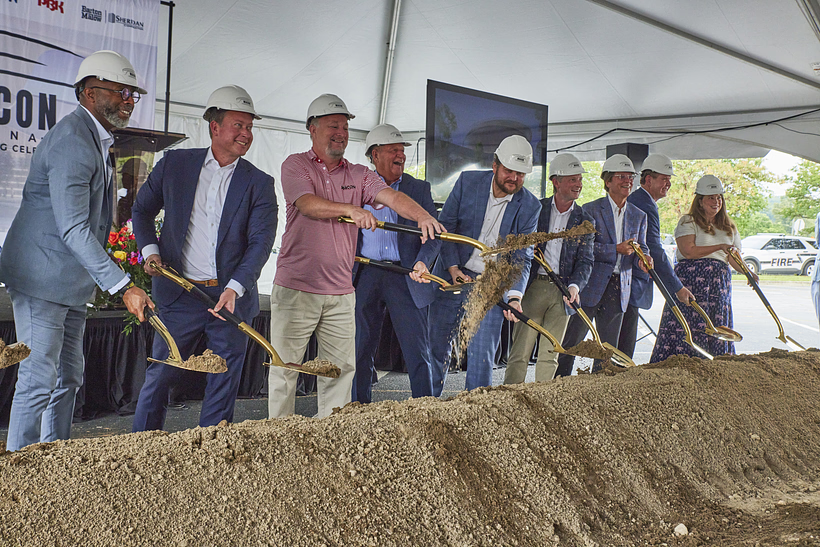
In late July on a hot Macon summer day, Macon-Bibb County officially broke ground on a new $350 million arena that promises to carry that legacy forward. Expected to open in late 2028, the 230,000-square-foot facility is designed not only to accommodate bigger events and a more modern architecture, but to reflect the character of the community it serves.
Rather than creating a venue that could exist anywhere, the design was created to feel unmistakably Macon. Flowing architectural lines evoke the Ocmulgee River and the facility creates a direct line to the Ocmulgee Mounds National Historical Park. The roof recalls the shape of a guitar pick, and subtle details pay tribute to the city’s deep musical roots. Inside, a permanent home for the Macon Sports Hall of Fame will celebrate local athletes.
The arena itself is built for flexibility, and especially for athletic events. With the capacity for modern touring concerts and big sporting events to conventions, graduations, and family entertainment, the venue can adapt to host a wide variety of experiences. An adjoining 30,000-square-foot flex hall expands its capabilities, creating space for trade shows, community events and even an additional sheet of ice for hockey tournaments and recreational programming.
One of the most interesting parts of the facility is how it will extend beyond entertainment. Macon-Bibb County and the Bibb County School District have entered into a partnership that would integrate instructional space into the arena, giving students hands-on CTAE (Career, Technical, and Agricultural Education) experience in subjects like culinary arts, audio-visual production, graphic design, and other career fields connected to the entertainment industry. The goal is to bring workforce development and economic opportunity directly into the building.
Mayor Lester M. Miller, who joked that as someone who is “slightly active on social media” that he’s seen negative comments, said during the groundbreaking ceremony. “[The Coliseum] has held generations and generations of memories. But time has passed and we are at a point where we need a facility that will create memories for the next several generations.”
“It represents the future of sports, of entertainment, of families coming together. It represents a beacon for young people.”
That sentiment echoed throughout the celebration, attended by elected officials, students, construction partners, and community members.
For Christy Kovac of Sheridan Construction, whose company built the original Coliseum nearly six decades ago, helping launch its successor represented both a full-circle moment and a reminder that great civic spaces evolve with the communities they serve. “This is my hometown, and this is personal,” Kovac said. “It is a legacy continuing — jobs, dreams, pride, and a new chapter for Macon.”
When the new arena opens in 2028, it will surely feature up-to-date amenities, improved sightlines, and the flexibility to host diverse events for up to 12,000 attendees. But like the Coliseum before it, it will become a place where communities gather to make memories — setting the stage for Macon’s next chapter.