
There’s many instances where music is a form of salvation for souls that are struggling, whether students in school or overcoming a troubled background. When words fail, music speaks volumes. Here are the stories of two Macon musicians who picked up an instrument to close up their wounds and embrace a brighter path.
Story by Brittny Johnson
Music is far more than entertainment or background noise; it is a lifeline, something that helps us grieve, heal, escape, and survive. Before people can explain what hurts, they often find a song that understands them first. Music has the unique ability to carry people through moments when words fall short. In conversations with two musicians, Amelia McMann and the “Sax-tavist” Chris Harvey, it became clear that music isn’t simply a hobby or talent. For both artists, music became salvation. It gave them purpose, healing, and a way to endure life’s most difficult moments.
For Amelia McMann, an upcoming sophomore at Rutland High School, music became deeply personal after a major medical procedure temporarily took away her ability to play. A percussionist in both marching and concert band, Amelia’s love for music began in elementary school. By middle school, she knew music was where she belonged.
“I decided I love music,” she said. “This is for me.”
Amelia plays several percussion instruments, including the snare drum and xylophone, and credits music with helping her process emotions and discover confidence within herself. One piano piece, “Icarus” by Tony Ann, inspired her to continue pursuing music.
That connection became even more meaningful after Amelia underwent surgery to correct pectus excavatum, a condition that required doctors to place a titanium bar in her chest. The recovery process forced her away from school, and from band, the outlet that had become central to her life.
“I missed music so much,” she explained. “I was very stubborn about my recovery because I wanted to practice.”
Returning to school was not easy. Amelia described feeling isolated and unsure of herself after months away from normal life. She could not carry a backpack, bend easily, or participate fully in everyday activities, and at times, she questioned whether she was good enough to continue.
“There was one time when I thought this is just too hard for me,” she admitted. “But if I felt like I wasn’t good enough for it, I just tried to make myself even better.”
Instead of walking away from music, she leaned into it harder. Through practice and perseverance, music became the thing that helped rebuild her confidence.
“Music helps me understand my emotions,” she said. “It’s a big part of coping. Listening to music helps you unlock and realize things about yourself.”
For Amelia, resilience was the greatest lesson. Despite surgery and physical limitations, she returned stronger than before. She hopes others who hear her story will understand that obstacles do not have to define them.
“If it feels like they’re going to give up,” she said, “they should just try it one more time.”
Amelia was sure to express gratitude to the people who supported her throughout her recovery and musical journey, specifically thanking her mother, Teri McMann, her father, Gerald McMann, and her band director, Corey Bronson, for continually encouraging her and pushing her to be her best.
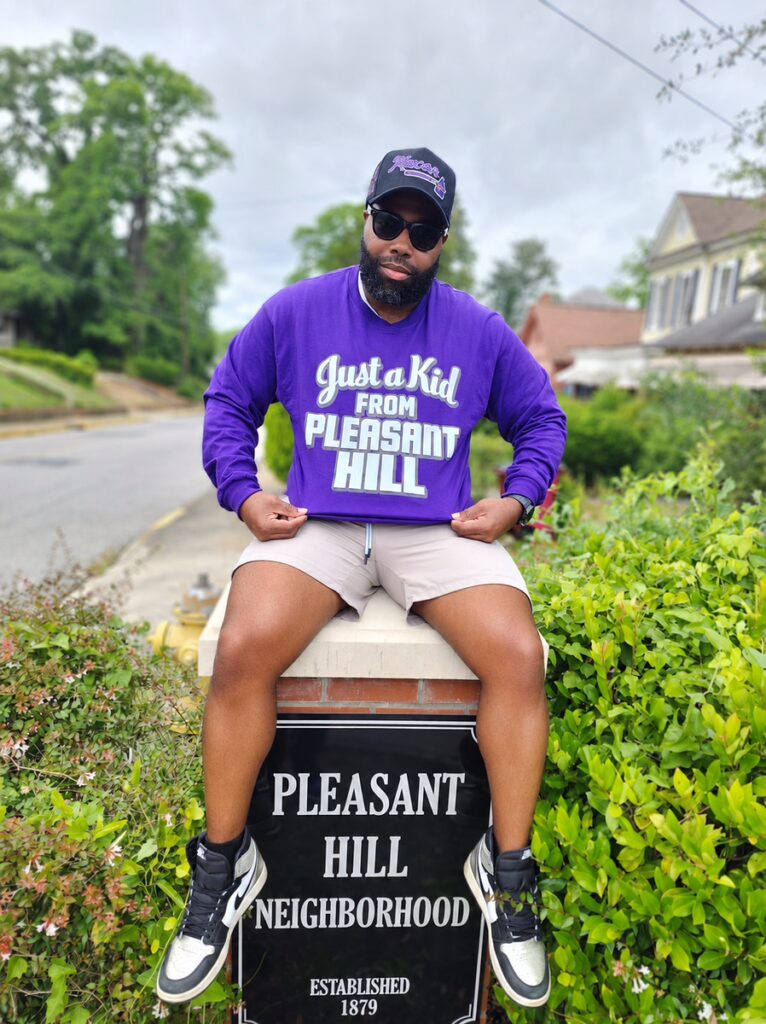
Like Amelia, Macon musician Chris Harvey also views music as something that saved his life. Born and raised in Macon’s Pleasant Hill neighborhood, which is near and dear to his heart, Harvey explained that music became a path away from trouble and toward purpose.
“If you know anything about Pleasant Hill,” he said, “music kept me out of a lot of trouble.”
Harvey recalled how friends and even family members became involved in fights and gangs while he spent his time in band practice and on music trips instead. Looking back, he believes music protected him from becoming a product of his environment.
“Had I not been in music,” he said, “I could’ve very easily been caught up in that.”
Harvey first fell in love with music in middle school after seeing a saxophone for the first time. Mesmerized by both its appearance and sound, he became determined to learn the instrument. Years later, he still owns that very first saxophone.
The name “Sax-tavist” reflects both his identity as a saxophonist and his belief in advocating for authentic music.
“Music is life,” he said. “It’s a universal language. Everybody has some type of music that can uplift them.”
Whether playing in church or at weddings, Harvey said he always hopes to communicate joy, love, and healing through his music. He views music as a combination of storytelling, activism, and restoration all at once.
Although deeply passionate about his craft, Harvey admitted there were moments when he doubted himself and even quit music temporarily as a child. Yet his love for the saxophone continually drew him back.
“What keeps me going is my love for it,” he said. “The passion for the gift that I have.”
Today, Harvey has performed alongside artists including Dottie Peoples, Ricco Barrino, and Anthony Hamilton. Still, his focus remains less on fame and more on authenticity, growth, and using his gift with purpose.
Both Amelia McMann and Chris Harvey prove that music is capable of doing much more than entertaining audiences. For them, music became healing in moments of pain, direction in moments of uncertainty, and hope in moments when giving up felt easier. Their stories remind us that music often meets people where nothing else can. It becomes the thing that steadies us when life feels overwhelming and the voice that speaks when our own words fail. In the end, music is not simply something they play; it is something that carried them through.