
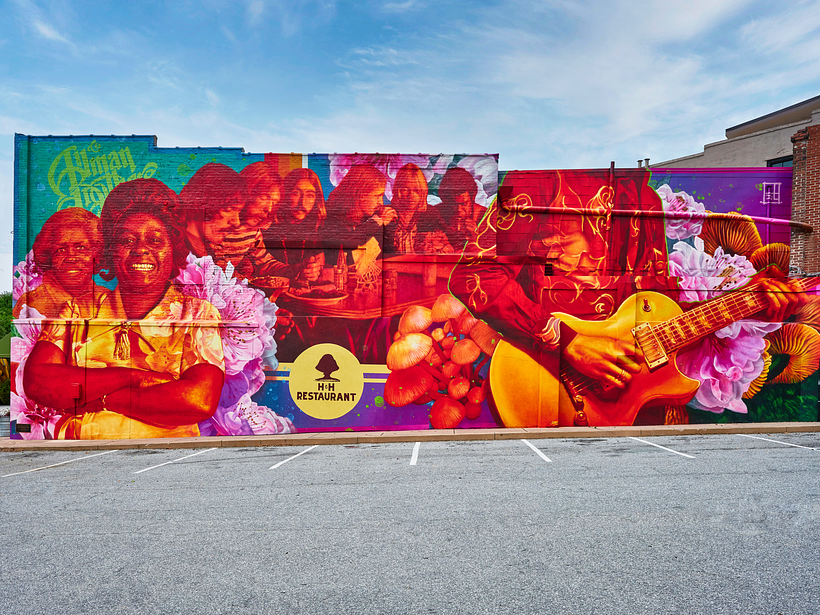
Story by Liz Fabian | Photos by Jessica Whitley
Downtown Macon resident Joe Adams is known as an artist, but considers himself just as much an historic preservationist.
When he learned a mural was planned on bare brick across from his downtown home, he started asking questions on Facebook.
“Is this an appropriate site for a mural? How are the sites chosen? Are neighbors considered? Does P&Z have to approve the location of murals like they do for signage and awnings?”
The answer to the first question might be a bit subjective, but the Second Street site that the mural was intended for is in a historic district with rules and regulations. As to whether the Macon-Bibb County Planning & Zoning Commission requires approval for murals — the answer is sometimes.
The Macon Arts Alliance learned that the hard way when planning the 4th annual Macon Mural Festival for September. It was never an issue in the years prior, but this was the first time two of the walls were unpainted brick in the historic Central Business District (CBD).
In the CBD, “the painting of unpainted masonry is inappropriate,” according to the regs, and “signs should not be painted onto previously unpainted brick facades.”
A HIGHLY UNIQUE COMMISSION
The county’s historic districts are regulated by the Design Review Board, whose recommendations are passed on to P&Z for the official decision.
P&Z’s five volunteers, who are appointed by Macon-Bibb County’s mayor and county commissioners, have the final say — unless you want to take them to Bibb Superior Court.
That’s the case for all zoning decisions, which makes this commission the only one of its kind in the state.
In the late 1940s, post-World War II growth had local leaders crying out for a regulatory board to protect property values and bring smart development.
A fledgling group of volunteers formed as a recommending body to the Macon City Council and Bibb County Commission.
Its first decision approved the commercial district on Ingleside Avenue from Corbin to Rogers Avenue, and led to an outcry from neighbors in the 300 block of Rogers.
They wanted to block the business development on one parcel on Rogers, and the city council sided with the neighbors and overruled P&Z.
Then Mayor Lewis B. Wilson was already working on plans to give independent authority to P&Z when that first board held the Ingleside hearing.
The 1946 Georgia General Assembly allowed for creation of such commissions.
Frustrated with the lack of authority, the first group disbanded, and The Telegraph’s editorial page was peppered with calls for the mayor, council, and commissioners to do something.
“Taxation is bad enough, but to have your property values depreciated by someone building a honky tonk or a drive-in theatre in front of your property is a terrible thing, but it is exactly what we face unless our two governing bodies get together and act quick,” an anonymous letter writer said.
The board as it is currently constituted was approved in 1952.
While members of the public might not appreciate having to take P&Z to court to reverse decisions, current executive director Jeff Ruggieri said he thinks it “works wonderfully” to remove politics out of the decisions.
The ten people serving on either the Design Review Board or the commission are the “best appointed officials he’s worked with in 27 years,” he said.
“They put a lot more weight on staff research and staff recommendations because the politics are not involved,” Ruggieri said.
The public is invited to comment on any matter before commissioners and agendas are publicly presented a month before each meeting to allow for input.
Mural festival organizers did not realize they needed a Certificate of Appropriateness until it was too late to meet legal deadlines, and postponed the event until May.
PAINTED WALLS SPARK DEBATE
It was late summer social media posts announcing the artists selected for the 2026 festival that alerted Adams of the plans to paint the side of Vintage Threads.
He’s watched the owners painstakingly renovate that 1910 building and create another downtown residence in the upper floors.
“I thought that these murals were supposed to be for locations that were sort of dilapidated, or have graffiti, or like the tunnel at the end of Poplar Street, not buildings that have been restored,” Adams said.
He doesn’t want to be known as the “Grinch” that stole the mural festival for raising what he believes are some important questions the community needs to navigate.
Macon Arts Alliance Executive Director Julie Wilkerson is pleased to have this conversation in the open because Macon’s Cultural Plan recommended a cultural officer to oversee and be a liaison for film, music, and public art.
“It really is a position for the county to fund,” Wilkerson said. “That person’s office needs to be in the government center. They need to be attending city council meetings. They need to be accessible to planning and zoning, and to security when there’s a film here, to talk to for licensing and what they need.”
Through this experience, Wilkinson realizes she “didn’t know what she didn’t know.”
She plans for the Arts Alliance to host P&Z staff to explain the rules for murals and renovations to artists and historic district property owners.
Mural festival organizers did not realize they needed a Certificate of Appropriateness until it was too late to meet legal deadlines and postponed the event until May.
In the spring, P&Z made artists from Franklin St. Studios paint over parts of their “All out Mayhem” mural that paid tribute to the city’s hockey team, the Macon Mayhem.
Because of the words on the sides of the building, the mascot logo, and the address, the painting was classified as a sign that was out of line with size requirements.
Adams said he supports local art but doesn’t want downtown saturated and the character of the historic district to be compromised.
“I don’t know that I want to walk out my door and see Puff the Magic Dragon or whoever or whatever,” Adams said.
The Arts Alliance wants to find sponsors for future murals outside of downtown.
Right now, It’s the sponsor and the artist who approve the designs, but that could change.
In 2018, Macon-Bibb created a public art board to coordinate local projects and determine compatibility for placement, but it sputtered out over the pandemic.
Wilkerson believes there’s a need for that type of oversight, especially for sculptures or other metal artwork that could potentially injure someone.
“Not really judging on whether or not they like the art, but on whether or not it’s appropriate for the place that it is,” she said.